
Introduction
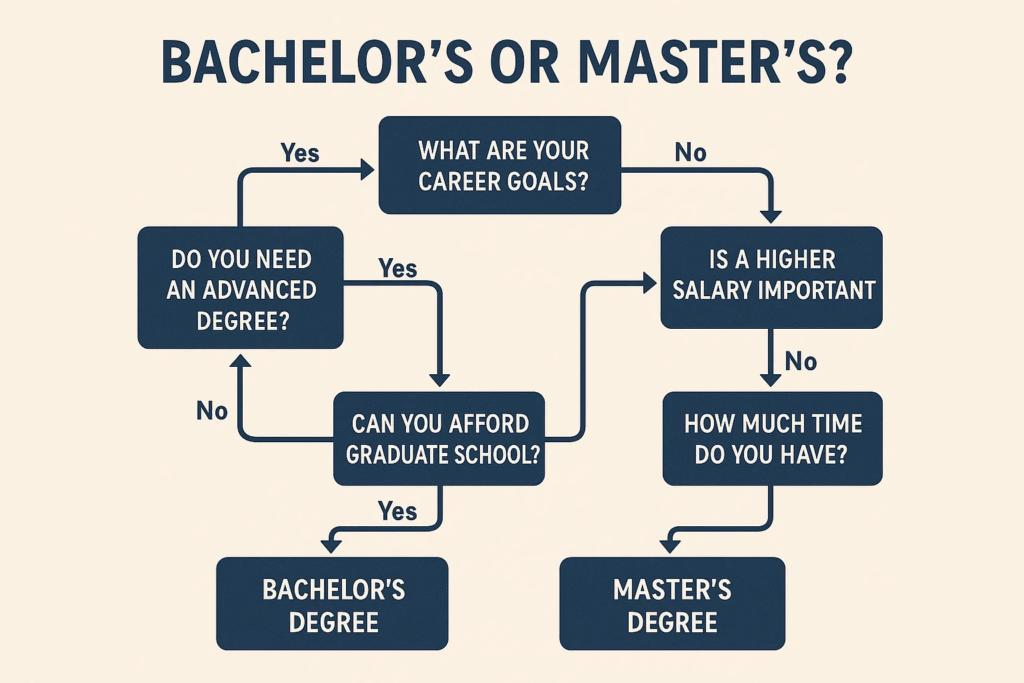
For many students, especially those newer to the U.S. education system, the distinction between a bachelor’s and master’s degree — and when each is necessary — isn’t always clear. Understanding these differences is important both for planning your education path and for evaluating whether graduate study aligns with your career goals. This guide breaks down the key differences between the two degree levels.
What Is a Bachelor’s Degree?
A bachelor’s degree is an undergraduate degree typically earned after four years of full-time study at a college or university in the United States. It usually combines general education requirements (covering a range of subjects) with coursework in a specific major, and often forms the foundational credential required for entry into many professional careers, as well as a prerequisite for most graduate programs.
Common types include:
- Bachelor of Arts (BA) — typically associated with humanities, social sciences, and some sciences
- Bachelor of Science (BS) — typically associated with more technical or scientific fields, often with more required coursework in math or lab sciences
What Is a Master’s Degree?
A master’s degree is a graduate-level degree typically earned after completing a bachelor’s degree, usually requiring one to two years of additional full-time study, though timelines vary by program and field. Master’s programs are generally more specialized and focused than undergraduate study, often preparing students for advanced professional roles or further academic research.
Common types include:
- Master of Arts (MA) and Master of Science (MS) — general academic graduate degrees in a specific field
- Master of Business Administration (MBA) — a professional graduate degree focused on business and management
- Master of Education (MEd), Master of Public Health (MPH), and other field-specific professional master’s degrees
Key Differences at a Glance
| Feature | Bachelor’s Degree | Master’s Degree |
|---|---|---|
| Typical Duration | 4 years (full-time) | 1–2 years (full-time), varies by program |
| Prerequisite | High school diploma or equivalent | Bachelor’s degree (in most cases) |
| Focus | Broad, foundational education plus a major | Specialized, advanced study in a specific field |
| Purpose | Entry-level career preparation, foundation for further study | Career advancement, specialization, or research preparation |
| Typical Admission Requirements | High school transcript, test scores (where required), essays | Bachelor’s transcript, sometimes GRE/GMAT, letters of recommendation, statement of purpose |
Why Pursue a Master’s Degree?
Common reasons students pursue a master’s degree include:
- Career advancement — some fields, such as certain areas of engineering, social work, or public administration, may see career progression benefit from or require a master’s degree
- Career change — a master’s degree can provide credentials and specialized knowledge to pivot into a new field
- Specialization — deepening expertise in a specific area beyond what an undergraduate degree covers
- Preparation for further graduate study — some fields use a master’s degree as a stepping stone toward doctoral study, though not all doctoral programs require a separate master’s degree first
Is a Master’s Degree Necessary?
Whether a master’s degree is necessary depends heavily on your specific field and career goals:
- Some careers, such as certain healthcare, education, and engineering roles, may require or strongly favor a master’s degree, or licensing may depend on it
- Many careers in business, technology, and other fields do not require a master’s degree, though it may still offer an advantage for certain roles or advancement paths
- Some professional fields (such as law and medicine) require distinct professional degrees (JD, MD) rather than a general master’s degree
Researching typical career requirements and consulting professionals in your intended field can help clarify whether a master’s degree is a meaningful investment for your specific goals.
Cost Considerations
Master’s degree programs often come with significant additional tuition costs, and financial aid policies for graduate study can differ significantly from undergraduate aid — many master’s programs offer less need-based grant aid and rely more heavily on loans, assistantships, or self-funding. Students considering graduate study should research typical costs and available funding (such as teaching or research assistantships) specific to their intended program.
Admission Requirements for Master’s Programs
While requirements vary significantly by program, common elements include:
- A completed bachelor’s degree (sometimes in a related field, depending on the program)
- Academic transcripts
- Standardized test scores where required (such as the GRE or GMAT, though many programs have become test-optional)
- Letters of recommendation
- A statement of purpose or personal essay
- Relevant work or research experience (for some programs)
Frequently Asked Questions
Do I need a master’s degree to get a good job?
Not necessarily — many well-paying and fulfilling careers only require a bachelor’s degree, though this varies significantly by field and specific career goals.
Can I go straight from a bachelor’s to a doctoral degree?
In some fields and programs, yes — a separate master’s degree is not always required before starting a doctoral program, though this varies by field and specific university.
How long does a master’s degree take?
Most full-time master’s programs take one to two years, though part-time or specialized programs may take longer or shorter, depending on the field and format.
Is an MBA the same as a general master’s degree?
An MBA (Master of Business Administration) is a specific type of professional master’s degree focused on business and management, distinct from general academic master’s degrees like an MA or MS.
Conclusion
The choice between stopping at a bachelor’s degree or pursuing a master’s degree depends heavily on your specific field, career goals, and financial circumstances. While a bachelor’s degree provides a broad foundation and is the standard entry credential for most careers, a master’s degree offers deeper specialization that can be valuable — or in some fields, necessary — for career advancement. Researching your specific field’s typical expectations and speaking with professionals in your intended career path can help guide this decision.
Internal Link Suggestions:
- → Most Popular University Degrees in the United States
- → How to Choose the Right University Course
- → How Financial Aid Works at U.S. Universities
- → Universities Hub
Suggested Authoritative Sources: National Center for Education Statistics (nces.gov), individual university graduate admissions pages, U.S. Bureau of Labor Statistics (bls.gov).
Image Alt-Text Suggestions: “Graduate student presenting master’s thesis research”, “Bachelor’s degree graduation ceremony”, “Student comparing undergraduate and graduate program options”