
SEO Title: Harvard University: Admissions, Tuition, Programs, Scholarships & Student Guide
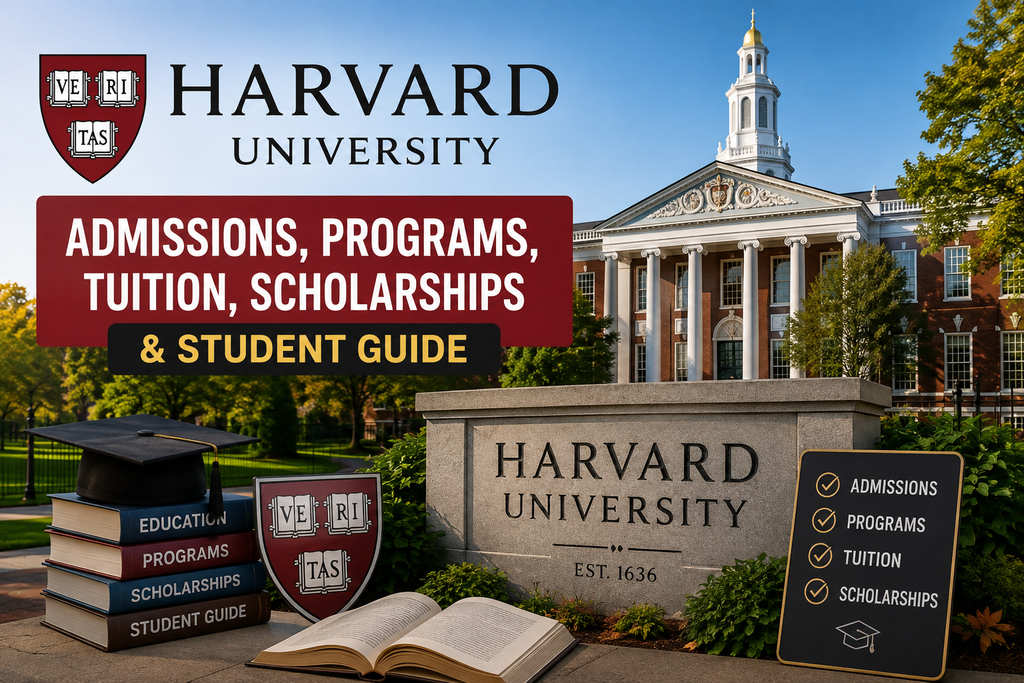
Harvard University: Admissions, Programs, Tuition, Scholarships & Student Guide
SEO Title: Harvard University: Admissions, Tuition, Programs, Scholarships & Student Guide
Meta Description: Explore Harvard University admissions, programs, tuition costs, scholarships, financial aid, campus life, and key information for prospective students.
Recommended URL Slug: /universities/harvard-university/
Search Intent: Informational / University Research
Primary Keyword: Harvard University
Secondary Keywords: Harvard University admissions, Harvard tuition, Harvard scholarships, Harvard financial aid, Harvard programs, Harvard College, study at Harvard, Harvard international students
Introduction
Harvard University is one of the most recognized names in higher education in the United States. Founded in 1636, Harvard has developed into a major research university with a broad range of undergraduate, graduate, and professional programs. Harvard College, the university’s undergraduate division, provides students with a liberal arts and sciences education while giving them considerable freedom to explore different academic fields.
For students considering Harvard, reputation is only one part of the decision. Prospective applicants also need to understand the admissions process, academic programs, tuition and living expenses, financial aid, campus environment, and what student life is actually like.
This guide provides an overview of Harvard University and the key information students should consider before applying.
Harvard University at a Glance
| Category | Information |
|---|---|
| University | Harvard University |
| Undergraduate Division | Harvard College |
| Founded | 1636 |
| Location | Cambridge, Massachusetts |
| Academic Focus | Liberal arts, sciences, research, and interdisciplinary study |
| Undergraduate Students | About 7,100 |
| Student-Faculty Ratio | About 7:1 |
| Application Platform | Common Application |
| Early Application Deadline | November 1 |
| Regular Decision Deadline | January 1 |
| 2026–27 Tuition | $62,226 |
| 2026–27 Billed Costs Before Aid | $91,634 |
Harvard College currently reports about 7,103 students and a 7:1 student-to-faculty ratio.
History and Background
How Harvard Started
Harvard College was founded in 1636 and is the oldest institution of higher education in the United States. The institution was originally established by the Massachusetts Bay Colony and was later named after John Harvard, a clergyman who left part of his estate and his library to the College.
Over the centuries, Harvard expanded from a small colonial college into a large research university. Today, Harvard University includes Harvard College along with numerous graduate and professional schools serving students in fields such as law, medicine, business, education, public health, government, and other disciplines.
Harvard College remains focused on undergraduate education and provides students with a broad liberal arts and sciences curriculum.
Development and Reputation
Harvard’s long history has contributed to its global reputation, but its academic identity is also built around research, interdisciplinary learning, faculty engagement, and intellectual exploration.
Students at Harvard College are encouraged to explore different subjects before concentrating on a particular academic field. This structure can be useful for students who have strong interests but are not yet certain which subject they want to pursue.
Academic Programs at Harvard
Undergraduate Programs
Harvard College offers a liberal arts and sciences education rather than limiting students to a narrow professional curriculum.
Students can explore subjects across the humanities, social sciences, natural sciences, mathematics, engineering, computer science, and other areas.
Harvard currently lists more than 3,700 courses across 50 undergraduate fields of study, known as concentrations. At Harvard, a concentration is generally equivalent to what many universities call a major.
Examples of academic areas include:
- Computer Science
- Economics
- Government
- History
- Biology
- Mathematics
- Statistics
- Psychology
- Applied Mathematics
- Engineering
- Environmental Science
- English
- Sociology
- Political Science
- Neuroscience
- African and African American Studies
Students can also pursue secondary fields, joint concentrations, double concentrations, and, in certain circumstances, specially designed concentrations.
Graduate Programs
Harvard University also operates a wide range of graduate and professional schools. These programs serve students who have already completed undergraduate education or meet the specific requirements of a professional program.
Graduate-level opportunities include areas such as:
- Business
- Law
- Medicine
- Education
- Public Health
- Government
- Design
- Engineering
- Arts and Sciences
- Divinity
- Dental Medicine
Graduate admissions are handled separately by the relevant Harvard school, so applicants should always check the specific school’s requirements.
Popular Fields of Study
Harvard’s broad academic environment makes it possible for students to study both traditional and interdisciplinary subjects.
Computer science, economics, government, biology, mathematics, engineering, social sciences, and humanities are among the many areas students can explore.
One advantage of Harvard’s liberal arts model is that students do not have to limit themselves to one subject from the beginning of their college experience.
Harvard University Admissions
Undergraduate Admission
Admission to Harvard College is highly selective, and the university evaluates applicants through a holistic admissions process.
For first-year applicants, Harvard accepts the Common Application. Applicants generally need to submit their application, school reports, teacher recommendations, academic records, standardized test results, and other required materials.
Harvard’s current first-year application deadlines are:
- Restrictive Early Action: November 1
- Regular Decision: January 1
Restrictive Early Action applicants normally receive decisions in mid-December, while Regular Decision applicants are notified by the end of March.
Because admissions requirements and deadlines can change, students should verify the dates on Harvard’s official admissions website before submitting an application.
General Admission Requirements
A first-year application normally includes:
- Common Application
- Harvard-specific application questions
- Application fee or fee waiver
- Secondary school report
- Counselor recommendation
- Official academic transcript or academic results
- Two teacher recommendations
- Standardized test scores
- Midyear school report when applicable
- Additional materials when relevant
Harvard states that application requirements are generally the same for domestic and international applicants, although international students may have different academic documents depending on their education system.
SAT and ACT Requirements
Harvard currently requires applicants to submit SAT or ACT scores as part of its standardized testing requirement.
In exceptional circumstances where an applicant cannot reasonably access the SAT or ACT, Harvard says certain alternative examination results may satisfy the testing requirement, including AP, IB, GCSE/A-Level, or national examination results, depending on the applicant’s situation.
Students should check Harvard’s current testing policy before applying because standardized testing policies can change.
International Applicants
Harvard welcomes applications from students around the world.
International applicants follow the same basic admissions process, but they may need to provide academic documents based on their country’s education system. Harvard also notes that English proficiency is important for successful study, while its admissions process does not require a separate English-language proficiency exam for all international applicants.
International students who are admitted and choose to enroll receive information about the student visa process.
Tuition and Costs at Harvard
Harvard Tuition
The cost of attending Harvard is significant before financial aid is considered.
For the 2026–2027 academic year, Harvard lists:
- Tuition: $62,226
- Fees: $6,216
- Housing: $14,250
- Food: $8,942
- Billed-cost subtotal: $91,634
Harvard also estimates additional personal, book, and transportation expenses, bringing the total estimated billed and unbilled cost to approximately $95,134–$100,134, depending on transportation expenses.
These figures represent published costs before financial aid and should not automatically be interpreted as the amount every student pays.
Housing and Living Expenses
Harvard College has a residential community system in which first-year students live together in Harvard Yard before moving into one of the College’s residential Houses for the remaining years.
Students should budget for more than tuition alone. Housing, food, books, personal expenses, transportation, and other costs can significantly affect the total cost of attendance.
The actual amount a family pays may be substantially lower when financial aid is included.
Scholarships and Financial Aid
Harvard Financial Aid
Harvard’s financial aid program is based on demonstrated financial need rather than traditional academic merit scholarships.
Harvard states that it meets 100% of demonstrated financial need and that admission is need-blind, meaning a student’s financial circumstances do not affect the admissions decision.
Harvard also reports that 25% of Harvard families pay nothing toward their child’s Harvard education under its financial aid system.
For students considering Harvard, this makes understanding financial aid especially important. A high published tuition price does not necessarily mean that every admitted student pays the full amount.
Financial Aid for International Students
International students can also receive Harvard financial aid.
Harvard states that international students are eligible for financial aid on the same basis as American students. The university’s aid system is based on demonstrated financial need rather than nationality.
International applicants who need financial assistance should carefully follow Harvard’s financial aid application instructions and deadlines.
Campus and Student Life
Campus Environment
Harvard’s main undergraduate campus is located in Cambridge, Massachusetts, near Harvard Square and across the Charles River from Boston.
The location combines a traditional university environment with access to a major metropolitan area. Students can take advantage of libraries, museums, research facilities, cultural activities, restaurants, public transportation, and the broader Boston-area academic community.
Student Organizations
Student life at Harvard extends beyond classrooms.
Students can participate in a wide range of organizations, activities, publications, athletic programs, cultural groups, academic societies, and service initiatives.
This variety allows students to build communities around academic interests, hobbies, leadership, culture, sports, and public service.
Housing and Student Facilities
Residential life is an important part of the Harvard College experience.
First-year students live together in Harvard Yard, and upper-level students join one of Harvard’s residential Houses. The residential system is designed to create communities that support students academically and socially.
Harvard also provides libraries, laboratories, academic advising, dining facilities, recreation opportunities, health services, and other resources designed to support students throughout their undergraduate years.
Rankings and Reputation
Harvard is widely recognized as one of the world’s leading universities. Its reputation is supported by its long history, research activity, faculty, alumni community, academic resources, and broad range of programs.
However, students should not evaluate Harvard solely by its position in any particular ranking.
Different ranking organizations use different methodologies, and rankings can change from year to year. A better approach is to consider factors such as:
- Academic programs
- Faculty and research opportunities
- Financial aid
- Location
- Campus culture
- Career goals
- Student support
- Cost after financial aid
For a prospective student, the best university is not necessarily the university with the highest ranking. It is the institution that fits the student’s academic, financial, and personal goals.
Why Students Choose Harvard University
There are several reasons students may consider Harvard.
1. Long Academic History
Harvard’s history dates back to 1636, giving it one of the longest traditions of higher education in the United States.
2. Broad Academic Choice
Students can explore more than 3,700 courses across approximately 50 undergraduate fields of study.
3. Liberal Arts Education
Harvard College allows students to study broadly while developing deeper expertise in a chosen concentration.
4. Research Opportunities
As part of a major research university, Harvard students have access to extensive academic and research resources.
5. Financial Aid
Harvard’s need-based financial aid program can significantly reduce the amount eligible families actually pay.
6. International Community
Students from many different countries and backgrounds contribute to the Harvard community, creating opportunities for cross-cultural learning.
Pros and Considerations
Pros
- Strong academic reputation
- Broad selection of undergraduate fields
- Flexible liberal arts and sciences curriculum
- Extensive research opportunities
- Large academic and professional network
- Need-based financial aid
- Financial aid available to international students
- Residential college experience
- Location near Boston and Cambridge
Considerations
- Admission is extremely competitive
- Published tuition and living costs are high before financial aid
- Students should carefully research their expected family contribution
- The academic environment can be demanding
- Students need to be proactive when selecting courses and planning their academic path
- International students must plan carefully for visas, documentation, travel, and financial aid
Frequently Asked Questions
Is Harvard University difficult to get into?
Yes. Harvard College is highly selective, so applicants should have strong academic preparation as well as meaningful achievements, interests, experiences, and personal qualities.
How much is Harvard tuition?
For 2026–2027, Harvard lists undergraduate tuition at $62,226. Additional fees, housing, food, and other expenses bring the published billed-cost subtotal to $91,634 before financial aid.
Does Harvard offer scholarships?
Harvard provides need-based financial aid rather than traditional merit-based scholarships. The university states that it meets 100% of demonstrated financial need.
Can international students receive financial aid at Harvard?
Yes. Harvard states that international students are eligible for financial aid on the same basis as American students.
What is the Harvard application deadline?
For first-year applicants, the Restrictive Early Action deadline is November 1, while the Regular Decision deadline is January 1.
Does Harvard require the SAT or ACT?
Harvard currently requires SAT or ACT scores. In exceptional circumstances, certain alternative examination results may satisfy the testing requirement.
What does Harvard call a major?
Harvard College generally uses the term concentration instead of major. Students can also pursue secondary fields and other academic options.
Where is Harvard University located?
Harvard University is located primarily in Cambridge, Massachusetts, in the Boston metropolitan area.
Is Harvard University only for graduate students?
No. Harvard College provides four-year undergraduate education, while Harvard University also includes graduate and professional schools.
Is Harvard a good choice for international students?
Harvard can be an attractive option for international students because of its broad academic opportunities and need-based financial aid. However, international applicants should carefully review admission requirements, financial aid procedures, visa requirements, and the overall cost of attendance before applying.
Conclusion
Harvard University offers students a combination of historic academic tradition, flexible undergraduate education, research opportunities, and a large university community.
For prospective applicants, the most important point is to look beyond Harvard’s name and reputation. Students should evaluate whether Harvard’s academic programs, campus environment, financial aid system, and learning culture match their individual goals.
The published cost of attendance can appear high, but Harvard’s need-based financial aid program may significantly reduce the amount eligible families pay. International students can also qualify for Harvard’s institutional financial aid.
Ultimately, a strong Harvard application requires careful preparation, strong academic performance, thoughtful application materials, and a clear understanding of the university’s requirements.
Internal Linking Suggestions for UniCoStudy.com
When the related articles are published, this Harvard University guide can link naturally to:
- Stanford University: Admissions, Programs, Tuition, Scholarships & Student Guide
- MIT: Admissions, Programs, Tuition, Scholarships & Student Guide
- How to Apply to U.S. Universities
- U.S. University Admission Requirements
- How to Find Scholarships for U.S. Universities
- Scholarships for International Students in the United States
- How U.S. University Rankings Work
- Cost of Living for Students in the United States
- What International Students Should Know Before Studying in the U.S.
Image Alt-Text Suggestion
Harvard University campus and Harvard College students in Cambridge Massachusetts
Recommended Authoritative Sources
For final publication checks, prioritize Harvard’s official admissions, financial aid, academic, and university history pages, especially for deadlines, tuition, testing requirements, and financial aid policies.
Meta Description: Explore Harvard University admissions, programs, tuition costs, scholarships, financial aid, campus life, and key information for prospective students.
Recommended URL Slug: /universities/harvard-university/
Search Intent: Informational / University Research
Primary Keyword: Harvard University
Secondary Keywords: Harvard University admissions, Harvard tuition, Harvard scholarships, Harvard financial aid, Harvard programs, Harvard College, study at Harvard, Harvard international students
Introduction
Harvard University is one of the most recognized names in higher education in the United States. Founded in 1636, Harvard has developed into a major research university with a broad range of undergraduate, graduate, and professional programs. Harvard College, the university’s undergraduate division, provides students with a liberal arts and sciences education while giving them considerable freedom to explore different academic fields.
For students considering Harvard, reputation is only one part of the decision. Prospective applicants also need to understand the admissions process, academic programs, tuition and living expenses, financial aid, campus environment, and what student life is actually like.
This guide provides an overview of Harvard University and the key information students should consider before applying.
Harvard University at a Glance
| Category | Information |
|---|---|
| University | Harvard University |
| Undergraduate Division | Harvard College |
| Founded | 1636 |
| Location | Cambridge, Massachusetts |
| Academic Focus | Liberal arts, sciences, research, and interdisciplinary study |
| Undergraduate Students | About 7,100 |
| Student-Faculty Ratio | About 7:1 |
| Application Platform | Common Application |
| Early Application Deadline | November 1 |
| Regular Decision Deadline | January 1 |
| 2026–27 Tuition | $62,226 |
| 2026–27 Billed Costs Before Aid | $91,634 |
Harvard College currently reports about 7,103 students and a 7:1 student-to-faculty ratio.
History and Background
How Harvard Started
Harvard College was founded in 1636 and is the oldest institution of higher education in the United States. The institution was originally established by the Massachusetts Bay Colony and was later named after John Harvard, a clergyman who left part of his estate and his library to the College.
Over the centuries, Harvard expanded from a small colonial college into a large research university. Today, Harvard University includes Harvard College along with numerous graduate and professional schools serving students in fields such as law, medicine, business, education, public health, government, and other disciplines.
Harvard College remains focused on undergraduate education and provides students with a broad liberal arts and sciences curriculum.
Development and Reputation
Harvard’s long history has contributed to its global reputation, but its academic identity is also built around research, interdisciplinary learning, faculty engagement, and intellectual exploration.
Students at Harvard College are encouraged to explore different subjects before concentrating on a particular academic field. This structure can be useful for students who have strong interests but are not yet certain which subject they want to pursue.
Academic Programs at Harvard
Undergraduate Programs
Harvard College offers a liberal arts and sciences education rather than limiting students to a narrow professional curriculum.
Students can explore subjects across the humanities, social sciences, natural sciences, mathematics, engineering, computer science, and other areas.
Harvard currently lists more than 3,700 courses across 50 undergraduate fields of study, known as concentrations. At Harvard, a concentration is generally equivalent to what many universities call a major.
Examples of academic areas include:
- Computer Science
- Economics
- Government
- History
- Biology
- Mathematics
- Statistics
- Psychology
- Applied Mathematics
- Engineering
- Environmental Science
- English
- Sociology
- Political Science
- Neuroscience
- African and African American Studies
Students can also pursue secondary fields, joint concentrations, double concentrations, and, in certain circumstances, specially designed concentrations.
Graduate Programs
Harvard University also operates a wide range of graduate and professional schools. These programs serve students who have already completed undergraduate education or meet the specific requirements of a professional program.
Graduate-level opportunities include areas such as:
- Business
- Law
- Medicine
- Education
- Public Health
- Government
- Design
- Engineering
- Arts and Sciences
- Divinity
- Dental Medicine
Graduate admissions are handled separately by the relevant Harvard school, so applicants should always check the specific school’s requirements.
Popular Fields of Study
Harvard’s broad academic environment makes it possible for students to study both traditional and interdisciplinary subjects.
Computer science, economics, government, biology, mathematics, engineering, social sciences, and humanities are among the many areas students can explore.
One advantage of Harvard’s liberal arts model is that students do not have to limit themselves to one subject from the beginning of their college experience.
Harvard University Admissions
Undergraduate Admission
Admission to Harvard College is highly selective, and the university evaluates applicants through a holistic admissions process.
For first-year applicants, Harvard accepts the Common Application. Applicants generally need to submit their application, school reports, teacher recommendations, academic records, standardized test results, and other required materials.
Harvard’s current first-year application deadlines are:
- Restrictive Early Action: November 1
- Regular Decision: January 1
Restrictive Early Action applicants normally receive decisions in mid-December, while Regular Decision applicants are notified by the end of March.
Because admissions requirements and deadlines can change, students should verify the dates on Harvard’s official admissions website before submitting an application.
General Admission Requirements
A first-year application normally includes:
- Common Application
- Harvard-specific application questions
- Application fee or fee waiver
- Secondary school report
- Counselor recommendation
- Official academic transcript or academic results
- Two teacher recommendations
- Standardized test scores
- Midyear school report when applicable
- Additional materials when relevant
Harvard states that application requirements are generally the same for domestic and international applicants, although international students may have different academic documents depending on their education system.
SAT and ACT Requirements
Harvard currently requires applicants to submit SAT or ACT scores as part of its standardized testing requirement.
In exceptional circumstances where an applicant cannot reasonably access the SAT or ACT, Harvard says certain alternative examination results may satisfy the testing requirement, including AP, IB, GCSE/A-Level, or national examination results, depending on the applicant’s situation.
Students should check Harvard’s current testing policy before applying because standardized testing policies can change.
International Applicants
Harvard welcomes applications from students around the world.
International applicants follow the same basic admissions process, but they may need to provide academic documents based on their country’s education system. Harvard also notes that English proficiency is important for successful study, while its admissions process does not require a separate English-language proficiency exam for all international applicants.
International students who are admitted and choose to enroll receive information about the student visa process.
Tuition and Costs at Harvard
Harvard Tuition
The cost of attending Harvard is significant before financial aid is considered.
For the 2026–2027 academic year, Harvard lists:
- Tuition: $62,226
- Fees: $6,216
- Housing: $14,250
- Food: $8,942
- Billed-cost subtotal: $91,634
Harvard also estimates additional personal, book, and transportation expenses, bringing the total estimated billed and unbilled cost to approximately $95,134–$100,134, depending on transportation expenses.
These figures represent published costs before financial aid and should not automatically be interpreted as the amount every student pays.
Housing and Living Expenses
Harvard College has a residential community system in which first-year students live together in Harvard Yard before moving into one of the College’s residential Houses for the remaining years.
Students should budget for more than tuition alone. Housing, food, books, personal expenses, transportation, and other costs can significantly affect the total cost of attendance.
The actual amount a family pays may be substantially lower when financial aid is included.
Scholarships and Financial Aid
Harvard Financial Aid
Harvard’s financial aid program is based on demonstrated financial need rather than traditional academic merit scholarships.
Harvard states that it meets 100% of demonstrated financial need and that admission is need-blind, meaning a student’s financial circumstances do not affect the admissions decision.
Harvard also reports that 25% of Harvard families pay nothing toward their child’s Harvard education under its financial aid system.
For students considering Harvard, this makes understanding financial aid especially important. A high published tuition price does not necessarily mean that every admitted student pays the full amount.
Financial Aid for International Students
International students can also receive Harvard financial aid.
Harvard states that international students are eligible for financial aid on the same basis as American students. The university’s aid system is based on demonstrated financial need rather than nationality.
International applicants who need financial assistance should carefully follow Harvard’s financial aid application instructions and deadlines.
Campus and Student Life
Campus Environment
Harvard’s main undergraduate campus is located in Cambridge, Massachusetts, near Harvard Square and across the Charles River from Boston.
The location combines a traditional university environment with access to a major metropolitan area. Students can take advantage of libraries, museums, research facilities, cultural activities, restaurants, public transportation, and the broader Boston-area academic community.
Student Organizations
Student life at Harvard extends beyond classrooms.
Students can participate in a wide range of organizations, activities, publications, athletic programs, cultural groups, academic societies, and service initiatives.
This variety allows students to build communities around academic interests, hobbies, leadership, culture, sports, and public service.
Housing and Student Facilities
Residential life is an important part of the Harvard College experience.
First-year students live together in Harvard Yard, and upper-level students join one of Harvard’s residential Houses. The residential system is designed to create communities that support students academically and socially.
Harvard also provides libraries, laboratories, academic advising, dining facilities, recreation opportunities, health services, and other resources designed to support students throughout their undergraduate years.
Rankings and Reputation
Harvard is widely recognized as one of the world’s leading universities. Its reputation is supported by its long history, research activity, faculty, alumni community, academic resources, and broad range of programs.
However, students should not evaluate Harvard solely by its position in any particular ranking.
Different ranking organizations use different methodologies, and rankings can change from year to year. A better approach is to consider factors such as:
- Academic programs
- Faculty and research opportunities
- Financial aid
- Location
- Campus culture
- Career goals
- Student support
- Cost after financial aid
For a prospective student, the best university is not necessarily the university with the highest ranking. It is the institution that fits the student’s academic, financial, and personal goals.
Why Students Choose Harvard University
There are several reasons students may consider Harvard.
1. Long Academic History
Harvard’s history dates back to 1636, giving it one of the longest traditions of higher education in the United States.
2. Broad Academic Choice
Students can explore more than 3,700 courses across approximately 50 undergraduate fields of study.
3. Liberal Arts Education
Harvard College allows students to study broadly while developing deeper expertise in a chosen concentration.
4. Research Opportunities
As part of a major research university, Harvard students have access to extensive academic and research resources.
5. Financial Aid
Harvard’s need-based financial aid program can significantly reduce the amount eligible families actually pay.
6. International Community
Students from many different countries and backgrounds contribute to the Harvard community, creating opportunities for cross-cultural learning.
Pros and Considerations
Pros
- Strong academic reputation
- Broad selection of undergraduate fields
- Flexible liberal arts and sciences curriculum
- Extensive research opportunities
- Large academic and professional network
- Need-based financial aid
- Financial aid available to international students
- Residential college experience
- Location near Boston and Cambridge
Considerations
- Admission is extremely competitive
- Published tuition and living costs are high before financial aid
- Students should carefully research their expected family contribution
- The academic environment can be demanding
- Students need to be proactive when selecting courses and planning their academic path
- International students must plan carefully for visas, documentation, travel, and financial aid
Frequently Asked Questions
Is Harvard University difficult to get into?
Yes. Harvard College is highly selective, so applicants should have strong academic preparation as well as meaningful achievements, interests, experiences, and personal qualities.
How much is Harvard tuition?
For 2026–2027, Harvard lists undergraduate tuition at $62,226. Additional fees, housing, food, and other expenses bring the published billed-cost subtotal to $91,634 before financial aid.
Does Harvard offer scholarships?
Harvard provides need-based financial aid rather than traditional merit-based scholarships. The university states that it meets 100% of demonstrated financial need.
Can international students receive financial aid at Harvard?
Yes. Harvard states that international students are eligible for financial aid on the same basis as American students.
What is the Harvard application deadline?
For first-year applicants, the Restrictive Early Action deadline is November 1, while the Regular Decision deadline is January 1.
Does Harvard require the SAT or ACT?
Harvard currently requires SAT or ACT scores. In exceptional circumstances, certain alternative examination results may satisfy the testing requirement.
What does Harvard call a major?
Harvard College generally uses the term concentration instead of major. Students can also pursue secondary fields and other academic options.
Where is Harvard University located?
Harvard University is located primarily in Cambridge, Massachusetts, in the Boston metropolitan area.
Is Harvard University only for graduate students?
No. Harvard College provides four-year undergraduate education, while Harvard University also includes graduate and professional schools.
Is Harvard a good choice for international students?
Harvard can be an attractive option for international students because of its broad academic opportunities and need-based financial aid. However, international applicants should carefully review admission requirements, financial aid procedures, visa requirements, and the overall cost of attendance before applying.
Conclusion
Harvard University offers students a combination of historic academic tradition, flexible undergraduate education, research opportunities, and a large university community.
For prospective applicants, the most important point is to look beyond Harvard’s name and reputation. Students should evaluate whether Harvard’s academic programs, campus environment, financial aid system, and learning culture match their individual goals.
The published cost of attendance can appear high, but Harvard’s need-based financial aid program may significantly reduce the amount eligible families pay. International students can also qualify for Harvard’s institutional financial aid.
Ultimately, a strong Harvard application requires careful preparation, strong academic performance, thoughtful application materials, and a clear understanding of the university’s requirements.
Internal Linking Suggestions for UniCoStudy.com
When the related articles are published, this Harvard University guide can link naturally to:
- Stanford University: Admissions, Programs, Tuition, Scholarships & Student Guide
- MIT: Admissions, Programs, Tuition, Scholarships & Student Guide
- How to Apply to U.S. Universities
- U.S. University Admission Requirements
- How to Find Scholarships for U.S. Universities
- Scholarships for International Students in the United States
- How U.S. University Rankings Work
- Cost of Living for Students in the United States
- What International Students Should Know Before Studying in the U.S.
Image Alt-Text Suggestion
Harvard University campus and Harvard College students in Cambridge Massachusetts
Recommended Authoritative Sources
For final publication checks, prioritize Harvard’s official admissions, financial aid, academic, and university history pages, especially for deadlines, tuition, testing requirements, and financial aid policies.