
SEO Title: Stanford University: Admissions, Tuition, Programs, Scholarships & Student Guide
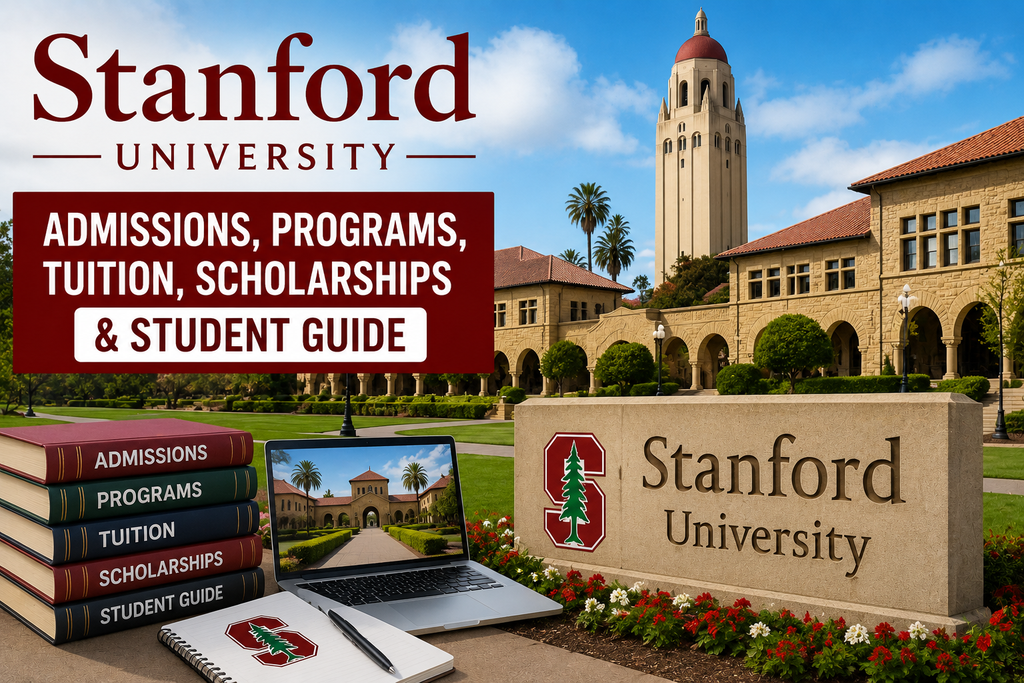
Meta Description: Learn about Stanford University admissions, academic programs, tuition, financial aid, scholarships, campus life, and important information for prospective students.
Recommended URL Slug: /universities/stanford-university/
Search Intent: Informational / University Research
Primary Keyword: Stanford University
Secondary Keywords: Stanford University admissions, Stanford tuition, Stanford scholarships, Stanford financial aid, Stanford programs, Stanford undergraduate programs, Stanford international students, study at Stanford
Introduction
Stanford University is one of the most prominent research universities in the United States and is widely known for its academic programs, research, innovation, and location in California’s San Francisco Bay Area.
Founded in 1885 by Leland and Jane Stanford, the university opened its doors to students in 1891. From its early history, Stanford was designed to provide a practical and broad education, and its academic culture continues to emphasize exploration, research, and interdisciplinary learning.
For students considering Stanford, the university’s reputation is only one part of the decision. Applicants should also understand the academic environment, admissions requirements, tuition and living expenses, financial aid, housing, student life, and the opportunities available to undergraduates.
This guide explains the major points prospective students should know about Stanford University before applying.
Stanford University at a Glance
| Category | Information |
|---|---|
| University | Stanford University |
| Founded | 1885 |
| Opened | 1891 |
| Location | Stanford, California |
| Region | San Francisco Bay Area |
| Undergraduate Students | 7,200+ |
| Student-Faculty Ratio | Approximately 5:1 |
| Undergraduate Majors | 66 fields of study |
| Application Platform | Common Application |
| Restrictive Early Action Deadline | November 1 |
| Regular Decision Deadline | January 5 |
| 2026–27 Tuition | $67,731 |
| 2026–27 Student Budget | $97,545, excluding travel |
| Undergraduate Degrees | B.A., B.S., B.A.S. |
Stanford reports more than 7,200 undergraduate students and an approximate 5-to-1 student-to-faculty ratio. Undergraduates can pursue Bachelor of Arts, Bachelor of Science, and Bachelor of Arts and Sciences degrees.
History and Background
How Stanford University Started
Stanford University was founded in 1885 by California Senator and former governor Leland Stanford and his wife, Jane Lathrop Stanford.
The university was created in memory of their only child, Leland Stanford Jr., who died of typhoid fever in 1884 at the age of 15. Following his death, the Stanfords decided to establish an institution that would benefit other young people.
The university opened on October 1, 1891, with approximately 555 students enrolled during its first year.
From its beginning, Stanford was intended to be different from many traditional universities of the era. It was established as a coeducational and nondenominational institution with an emphasis on practical education and public service.
Development and Reputation
Over time, Stanford developed into a major research university with seven schools covering fields ranging from engineering and humanities to medicine, business, law, education, and sustainability.
Its location in the San Francisco Bay Area has also contributed to Stanford’s strong connection with technology, entrepreneurship, research, and innovation.
Today, Stanford describes itself as a university focused on discovery, critical thinking, interdisciplinary learning, and applying knowledge to real-world challenges.
Academic Programs at Stanford
Undergraduate Programs
Stanford provides a broad undergraduate education that combines specialization with exploration.
The university currently offers 66 undergraduate fields of study. Students can explore different academic areas before formally choosing a major, giving them time to understand their interests and goals.
Undergraduate academic areas include fields such as:
- Computer Science
- Engineering
- Biology
- Economics
- Mathematics
- Psychology
- Political Science
- Human Biology
- Mechanical Engineering
- Electrical Engineering
- Symbolic Systems
- Environmental Sciences
- History
- English
- Communication
- Physics
- Chemistry
Stanford’s major offerings include traditional disciplines as well as interdisciplinary and specially designed programs.
Graduate Programs
Stanford also offers extensive graduate and professional education.
Its seven schools are:
- Graduate School of Business
- Graduate School of Education
- School of Engineering
- School of Humanities and Sciences
- Stanford Law School
- Stanford School of Medicine
- Stanford Doerr School of Sustainability
Graduate admissions are managed by individual schools and departments, so students applying for master’s, doctoral, or professional programs should review the requirements for their specific program.
Popular Fields of Study
Stanford is particularly well known for academic areas connected with science, technology, engineering, mathematics, entrepreneurship, and research.
However, students can also study humanities, social sciences, arts, education, sustainability, and other disciplines.
The university’s broad academic structure allows students to combine different interests rather than limiting their education to one narrow subject.
Stanford University Admissions
Undergraduate Admission
Stanford’s undergraduate admission process is highly selective and evaluates applicants holistically.
For first-year applicants, Stanford requires the Common Application, application fee or fee waiver request, standardized test scores, school report and counselor recommendation, official academic records, and recommendations from two academic teachers.
Stanford currently offers two main first-year application plans:
- Restrictive Early Action
- Regular Decision
The standard application deadlines are:
- Restrictive Early Action: November 1
- Regular Decision: January 5
Students applying with an optional arts portfolio have earlier deadlines. Stanford lists October 15 for Restrictive Early Action arts-portfolio applications and December 5 for Regular Decision arts-portfolio applications.
Students should always confirm deadlines directly with Stanford before applying because application policies can change.
General Admission Requirements
A Stanford first-year application generally includes:
- Common Application
- Application fee or fee waiver request
- ACT or SAT scores
- School report
- Counselor recommendation
- Official high school transcript or academic results
- Two academic teacher recommendations
- Midyear transcript when required
- Additional materials where applicable
Stanford requires an official transcript covering grades 9–12. Students following international curricula may need to provide academic results and predicted results when available.
Stanford does not prescribe one fixed high school curriculum for admission. However, the university recommends that students build a strong academic foundation across English, mathematics, social studies, science, and world languages while taking rigorous courses appropriate to their circumstances.
SAT and ACT Requirements
Stanford currently requires SAT or ACT scores for first-year applicants.
The university states that there are no minimum test scores required for admission and that no particular score guarantees admission. Stanford evaluates test scores as one component of its broader holistic application review.
Stanford does not prefer the SAT over the ACT.
For students who submitted scores in the Class of 2028, Stanford reports a middle 50 percent SAT range of 1510–1570 and a middle 50 percent ACT range of 34–35. These figures describe students who submitted scores and should not be interpreted as minimum requirements or guaranteed admission scores.
Students applying to Stanford should check the university’s current testing page for the latest testing deadlines and reporting policies.
International Students
Applying From Outside the United States
Stanford accepts applications from students around the world.
International applicants generally follow the same undergraduate application process, but their academic documentation can differ depending on the educational system they attend.
For example, students following international curricula such as IB, A-Levels, or national curricula may need to submit the relevant academic results or predicted results.
International students should also carefully plan for:
- Academic documentation
- Standardized testing
- Financial aid
- Visa requirements
- Travel expenses
- Health insurance
- Housing
- U.S. immigration requirements
Financial Aid for International Students
Stanford provides financial aid to some international undergraduate students, but its policy differs from the aid available to domestic students.
Stanford states that it has a limited amount of financial aid for international students. International applicants who need financial assistance must indicate this when applying for admission. Students who do not request consideration for financial aid during the admission process generally cannot later apply for Stanford need-based undergraduate aid during their undergraduate years.
This makes it especially important for international applicants to understand Stanford’s financial aid requirements before submitting an application.
Tuition and Costs at Stanford
Stanford Tuition
The published cost of attending Stanford is substantial before financial aid.
For the 2026–2027 academic year, Stanford’s undergraduate student budget lists:
- Tuition: $67,731
- Housing and food: $22,944
- Student fees allowance: $2,610
- Books and supplies: $855
- Personal expenses: $3,405
- Travel: Varies
- Total: $97,545, before travel expenses
New students also have one-time charges for the New Student Orientation Fee and Document Fee.
These published figures represent the estimated student budget before considering a student’s individual financial aid package.
Housing and Living Expenses
Housing and food represent a significant portion of Stanford’s annual student budget.
Stanford provides undergraduate housing, and its housing system includes a variety of residential options.
As of autumn 2025, Stanford reported that approximately 98% of eligible undergraduates lived in campus housing. Housing is guaranteed for entering undergraduate first-year students for four years.
Students should still review their individual housing and dining costs because expenses can vary according to their specific arrangements.
Scholarships and Financial Aid
Need-Based Financial Aid
Stanford emphasizes need-based financial assistance for undergraduate students.
The university reports that about two-thirds of its students receive some form of aid, while 60% receive Stanford scholarships, including athletic scholarships.
Stanford also states that domestic students whose family income is below $150,000 generally pay no tuition when their assets are typical for that income level. Families with income at or below $100,000 and typical assets may qualify for aid covering tuition, room, and board. Individual circumstances determine actual eligibility.
These policies mean that the published cost of attendance should not automatically be treated as the amount every student will pay.
Merit-Based Scholarships
Stanford’s primary undergraduate financial aid model is need-based rather than a broad merit-scholarship system.
Stanford states that athletic scholarships are the only merit-based scholarships offered by the university.
Students can also investigate outside scholarships and other funding sources where appropriate.
Financial Aid Application
Financial aid requirements depend on citizenship status and the admission application type.
For example, U.S. citizens and eligible noncitizens applying through Regular Decision generally need to complete the CSS Profile and FAFSA for need-based institutional scholarship consideration, along with required documentation. Stanford lists February 15 as the priority filing date for Regular Decision applicants.
International students have different financial aid requirements and should follow Stanford’s instructions for international applicants.
Campus and Student Life
Campus Environment
Stanford is located in the San Francisco Bay Area, in California.
The campus is known for its large scale, distinctive architecture, open spaces, research facilities, and residential communities.
Its location also places students near the broader Bay Area, a region associated with technology, entrepreneurship, research, culture, and business.
Stanford describes its campus environment as one centered on openness, exploration, and possibility.
Student Organizations
Student life at Stanford extends well beyond academic classes.
Students can participate in:
- Student clubs
- Academic organizations
- Cultural groups
- Performing arts
- Athletics
- Entrepreneurship activities
- Community service
- Research projects
- Student publications
- Political and social organizations
The wide range of activities allows students to develop interests outside their primary field of study.
Housing and Residential Life
Residential life is a major part of the Stanford undergraduate experience.
Stanford’s undergraduate housing system includes numerous residential facilities and communities. The university reported approximately 6,727 students living in university-provided undergraduate housing as of autumn 2025.
For many students, living on campus can make it easier to participate in academic activities, student organizations, social events, and university programs.
Research and Academic Opportunities
One of Stanford’s major strengths is its emphasis on research and discovery.
The university reports that its undergraduate research programs support approximately 1,200 students each year, with nearly $7.5 million in annual undergraduate research support through the Office of the Vice Provost for Undergraduate Education.
Research opportunities span numerous areas, including:
- Engineering
- Computer science
- Natural sciences
- Medicine
- Social sciences
- Humanities
- Arts
- Sustainability
This research environment can be particularly valuable for students considering graduate school, scientific careers, technology, entrepreneurship, or research-oriented professions.
Choosing a Major at Stanford
Stanford gives students considerable flexibility when selecting their academic direction.
The university’s undergraduate students can explore different fields before declaring a major. Stanford’s academic information states that students typically choose a major by the end of their sophomore year.
This approach can be useful for students who enter university with multiple interests.
Students can explore courses, speak with academic advisers, participate in introductory programs, and gain experience before committing to a particular field.
Stanford also offers minors, joint majors, interdisciplinary programs, honors programs, and other academic options.
Rankings and Reputation
Stanford University is widely recognized as a leading global research university.
Its reputation comes from several factors, including:
- Research activity
- Academic programs
- Faculty
- Innovation
- Entrepreneurship
- Research facilities
- Alumni network
- Interdisciplinary education
- Location in the San Francisco Bay Area
However, students should avoid judging Stanford only by its position in a particular university ranking.
Different ranking organizations use different methodologies, and rankings can change from year to year.
A better comparison should include:
- Academic program quality
- Cost after financial aid
- Campus environment
- Research opportunities
- Student support
- Career goals
- Location
- Housing
- Personal academic interests
Why Students Choose Stanford University
1. Strong Academic Environment
Stanford offers a broad range of undergraduate and graduate programs across seven schools.
2. Research Opportunities
Undergraduate students can participate in research across many disciplines, with university programs specifically designed to support student research.
3. Flexible Academic Exploration
Students have time to explore different subjects before declaring a major, which can be valuable for students with multiple interests.
4. Technology and Innovation
Stanford’s location and academic culture provide students with opportunities to interact with the wider technology and entrepreneurial ecosystem of the Bay Area.
5. Undergraduate Financial Support
Stanford provides substantial need-based financial aid, although eligibility differs according to family circumstances and citizenship status.
6. Campus Housing
A large majority of eligible undergraduates live in university housing, creating a strong residential component to student life.
7. Global Learning Opportunities
Stanford’s Bing Overseas Studies Program offers opportunities for students to study in locations around the world, including Australia, Berlin, Cape Town, Florence, Hong Kong, Kyoto, Madrid, New York, Oxford, Paris, and Santiago.
Pros and Considerations
Pros
- Strong global academic reputation
- Broad range of undergraduate majors
- Flexible academic exploration
- Extensive research opportunities
- Seven academic schools
- Strong technology and innovation ecosystem
- Large residential campus
- Undergraduate financial aid
- International study opportunities
- Access to the San Francisco Bay Area
Considerations
- Admission is extremely competitive
- Published annual costs are high before financial aid
- International financial aid is limited
- Academic programs can be demanding
- Students need to plan their academic path carefully
- Living expenses in the Bay Area can be significant
- Applicants should carefully review current testing and financial-aid policies
Frequently Asked Questions
Is Stanford University hard to get into?
Yes. Stanford is highly selective, and admission is competitive. The university evaluates applications holistically rather than relying on one academic measure or test score.
How much does Stanford University cost?
For 2026–2027, Stanford lists tuition at $67,731 and a total undergraduate student budget of $97,545, excluding travel.
Does Stanford offer scholarships?
Yes. Stanford provides need-based undergraduate financial aid and also offers athletic scholarships. Stanford states that athletic scholarships are its only merit-based scholarships.
Does Stanford give financial aid to international students?
Yes, but international financial aid is limited. International applicants who need financial assistance must request consideration when applying for admission.
What is Stanford’s application deadline?
For first-year applicants, the standard Restrictive Early Action deadline is November 1, while the Regular Decision deadline is January 5.
Does Stanford require the SAT or ACT?
Yes. Stanford currently requires ACT or SAT scores for first-year applicants. There is no minimum score required for admission and no score guarantees admission.
How many undergraduate majors does Stanford offer?
Stanford currently lists 66 undergraduate fields of study.
When do Stanford students declare a major?
Students generally declare a major by the end of their sophomore year.
Where is Stanford University located?
Stanford University is located in California’s San Francisco Bay Area.
Is Stanford good for international students?
Stanford can be an attractive option for international students because of its academic programs, research opportunities, global community, and access to the Bay Area. However, international applicants should pay particular attention to the university’s financial aid policy because international financial aid is limited.
Conclusion
Stanford University combines a broad undergraduate education with extensive research, interdisciplinary study, innovation, and a strong residential campus environment.
For prospective students, Stanford’s reputation should be only one part of the decision. Applicants should also consider their intended field of study, academic goals, financial circumstances, campus preferences, and long-term career plans.
The published cost of attendance is substantial, but Stanford’s need-based financial aid can significantly reduce the amount eligible students and families actually pay. At the same time, international students should understand that Stanford’s financial aid for international applicants is limited and must generally be requested during the admission process.
For students who value academic exploration, research, innovation, and a flexible undergraduate experience, Stanford can be an excellent university to consider.
Internal Linking Suggestions for UniCoStudy.com
Once the related articles are published, this Stanford University article can link naturally to:
- Harvard University: Admissions, Programs, Tuition, Scholarships & Student Guide
- Massachusetts Institute of Technology (MIT): Admissions, Programs, Tuition, Scholarships & Student Guide
- How to Apply to U.S. Universities
- U.S. University Admission Requirements
- How to Prepare a Strong University Application
- How to Find Scholarships for U.S. Universities
- Scholarships for International Students in the United States
- How U.S. University Rankings Work
- How to Compare Two U.S. Universities Before Applying
- What International Students Should Know Before Studying in the U.S.
Image Alt-Text Suggestion
Stanford University campus with students walking near the Main Quad in California
Authoritative Sources to Use for Publication Checks
For final updates before publishing, use Stanford University’s official admissions, financial aid, academics, history, and student-life pages, particularly for current deadlines, tuition, testing policies, and financial-aid requirements.