
SEO Title: Yale University Admissions, Tuition, Programs & Scholarships Guide
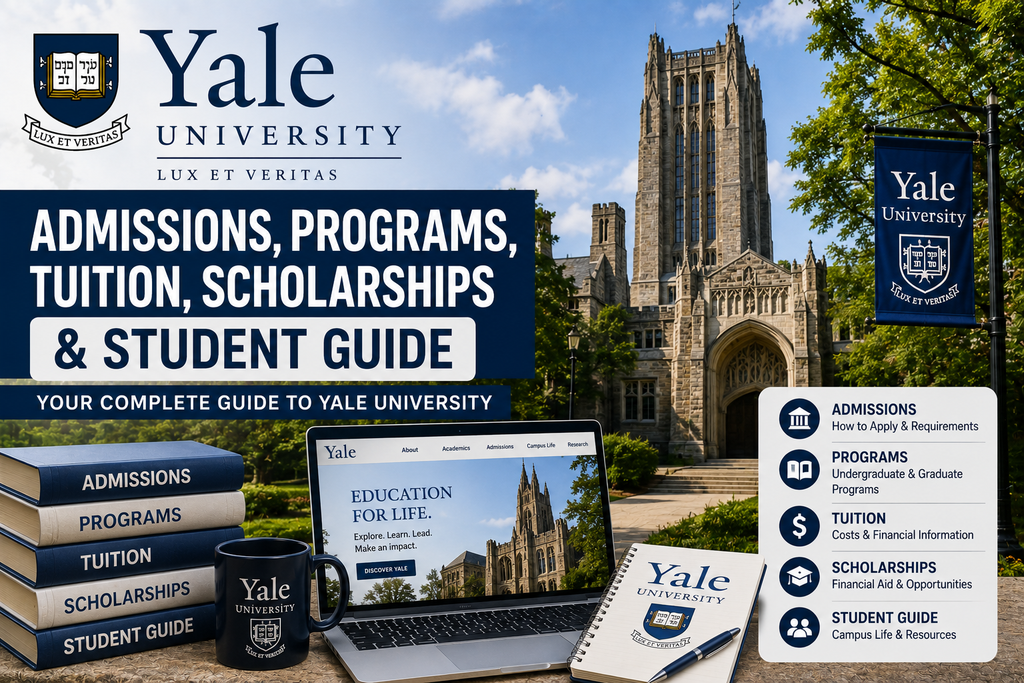
Meta Description: Explore Yale University admissions, programs, tuition, scholarships, financial aid, campus life, residential colleges, and important information for prospective students.
Recommended URL Slug:/universities/yale-university/
Search Intent: Informational / University Research
Primary Keyword: Yale University
Secondary Keywords: Yale University admissions, Yale tuition, Yale scholarships, Yale financial aid, Yale undergraduate programs, Yale acceptance, Yale student life, Yale residential colleges
Introduction
Yale University is one of the oldest and most recognized universities in the United States. Founded in 1701, Yale began as the Collegiate School and later moved to New Haven, Connecticut. It became Yale College in 1718 in recognition of Elihu Yale’s support and eventually developed into Yale University.
Today, Yale combines a broad liberal arts and sciences education with extensive research opportunities, graduate and professional schools, libraries, museums, and a distinctive residential college system.
For students considering an education at Yale, the decision involves much more than reputation. Applicants should understand the university’s academic structure, admission requirements, testing policy, tuition and living costs, financial aid, and campus environment.
This guide provides an overview of Yale University and the factors prospective students should consider before applying.
Yale University at a Glance
| Category | Information |
|---|---|
| University | Yale University |
| Founded | 1701 |
| Location | New Haven, Connecticut |
| Undergraduate institution | Yale College |
| Academic focus | Liberal arts, sciences, research and interdisciplinary study |
| Undergraduate majors | 80+ |
| Residential colleges | 14 |
| 2026–27 inclusive undergraduate fee | $94,100 |
| Early Action deadline | November 1 |
| Regular Decision deadline | January 2 |
| Testing policy | SAT or ACT required |
| Financial aid | Need-based |
| International financial aid | Available |
Yale’s 2026–27 inclusive fee for resident undergraduates is $94,100 and includes tuition, housing, meals and several university services.
History and Background
How Yale University Started
Yale traces its history to the early 1700s. In 1701, the Connecticut legislature established a collegiate school. The institution moved to New Haven in 1716 and was renamed Yale College in 1718 after Elihu Yale made a significant donation of books and goods.
The original institution was designed around a traditional liberal education. Over the following centuries, Yale expanded its academic mission and developed into a comprehensive research university.
Yale College remains the undergraduate institution within Yale University, while the wider university includes numerous graduate and professional schools.
Development and Reputation
Yale’s long history has contributed to its global academic reputation. The university has developed strengths across humanities, social sciences, natural sciences, engineering, arts, and professional education.
Its location in New Haven also gives students access to a university-centered city while remaining within relatively easy reach of major northeastern U.S. cities.
Academic Programs
Undergraduate Programs
Undergraduate education at Yale is provided through Yale College. Students can explore a wide range of subjects before and during their choice of major.
Yale currently describes its undergraduate curriculum as offering 80+ majors, covering disciplines ranging from anthropology and architecture to economics, engineering, history, psychology, statistics, and the arts.
Examples of academic areas include:
- Economics
- Political Science
- Biology
- Psychology
- Computer Science
- Engineering
- History
- Mathematics
- Statistics
- Architecture
- Art
- Astronomy
- Environmental Studies
- International and Global Studies
- Languages and Literature
Students can use Yale’s major roadmaps and academic advising resources to compare different fields of study and understand typical course pathways.
Graduate Programs
Yale University also offers graduate and professional education across a wide range of disciplines.
Its broader academic community includes schools and programs in areas such as:
- Law
- Medicine
- Management
- Engineering
- Architecture
- Art
- Music
- Public Health
- Nursing
- Divinity
- Drama
- Graduate Arts and Sciences
This creates opportunities for interdisciplinary interaction between undergraduate, graduate, and professional students.
Popular Fields of Study
Students interested in Yale may consider fields across the humanities, sciences, social sciences, and professional-oriented disciplines.
The university’s academic breadth is particularly useful for students who want to explore multiple interests rather than commit immediately to one narrow career path.
Yale also allows students to investigate potential majors through introductory courses and academic advising before making longer-term decisions.
Yale University Admissions
Yale is highly selective, so prospective applicants should approach the application process carefully and present a strong overall academic and personal profile.
Undergraduate Admission
First-year applicants can apply through one of three platforms:
- Common Application
- Coalition Application on SCOIR
- QuestBridge Application
Applicants submit only one application during an admissions cycle. Yale also requires recommendation letters, a school report with transcript, and standardized test scores.
Yale Admission Deadlines
For first-year applicants, Yale currently lists these deadlines:
| Application Program | Deadline |
|---|---|
| Single-Choice Early Action | November 1 |
| QuestBridge National College Match | November 1 |
| Regular Decision | January 2 |
Yale’s Single-Choice Early Action program is non-binding. Students admitted through the program may still apply to and maintain active applications at other colleges under the program’s rules.
General Admission Requirements
Applicants should carefully review Yale’s current requirements before applying.
The application generally includes:
- Completed application
- School report
- Academic transcript
- Teacher recommendations
- Standardized testing
- Required Yale-specific application materials
- Additional materials where applicable
Because requirements can change, students should always confirm the current requirements on Yale’s official admissions website before submitting an application.
Yale Standardized Testing Policy
Yale currently requires first-year and transfer applicants to submit SAT or ACT scores. Yale does not prefer one of these tests over the other.
For applicants using the ACT, Yale specifies the required sections, while the Science and Writing sections are optional.
International applicants may also need to provide an English proficiency test depending on their educational background. Yale lists TOEFL, IELTS, Cambridge English, and Duolingo English Test among its accepted options.
Students should check Yale’s testing page for the latest requirements before applying because testing policies can change between admission cycles.
Tuition and Costs
Yale Tuition and Fees
For the 2026–27 academic year, Yale lists an inclusive fee of $94,100 for resident undergraduates.
This amount includes:
- Tuition
- Housing
- Meals
- Library services
- Laboratory fees
- Gymnasium services
- Certain university fees
- Network services
Yale lists a separate tuition charge of $72,500 for nonresident students, with housing and meals charged separately.
Housing and Living Expenses
Housing is an important part of the Yale undergraduate experience because the university’s residential college system is central to student life.
For 2026–27, Yale lists annual housing charges of $12,080 and meal-plan charges of $9,520 for nonresident students under its financial-services schedule.
Students should also budget for expenses such as:
- Books and course materials
- Personal expenses
- Transportation
- Travel
- Health-related costs
- Technology and other academic needs
Actual costs can vary depending on individual circumstances.
Scholarships and Financial Aid
University Financial Aid
Yale College does not offer merit scholarships or athletic scholarships. Instead, its undergraduate financial aid program is based on demonstrated financial need.
This distinction is important for applicants. Students should not assume that academic achievement automatically produces a merit scholarship at Yale.
Instead, families seeking financial assistance should complete the required financial aid process.
Need-Blind Admission
Yale states that it is need-blind, meaning that a student’s financial need and interest in financial aid do not factor into the admissions decision.
This can make Yale particularly attractive to students who may otherwise be concerned that requesting financial assistance could reduce their admission chances.
Financial Aid for International Students
Yale provides need-based financial aid to undergraduate students regardless of citizenship or immigration status.
International students who want to apply for need-based aid should indicate their interest when submitting their admissions application. Yale then provides instructions for the required financial-aid materials.
International applicants should pay close attention to Yale’s specific financial-aid documentation requirements because the university does not simply substitute the International Student Financial Aid Application (ISFAA) for its required forms.
Campus and Student Life
Campus Environment
Yale’s campus combines historic architecture with modern academic, residential, cultural, and research facilities.
Students have access to resources including:
- Libraries
- Museums
- Art galleries
- Laboratories
- Performance spaces
- Dining facilities
- Student centers
- Athletic facilities
- Residential communities
The campus is located in New Haven, Connecticut, creating a university environment where academic and student activities are closely connected to the surrounding city.
Yale’s Residential College System
One of Yale’s most distinctive features is its residential college system.
Yale has 14 residential colleges, including:
- Benjamin Franklin College
- Berkeley College
- Branford College
- Davenport College
- Ezra Stiles College
- Grace Hopper College
- Jonathan Edwards College
- Morse College
- Pauli Murray College
- Pierson College
- Saybrook College
- Silliman College
- Timothy Dwight College
- Trumbull College
Incoming undergraduates are assigned to a residential college, which becomes an important part of their academic and social experience throughout their time at Yale.
Residential colleges provide communities where students can interact with peers, faculty, advisers, and staff.
Student Organizations
Yale students can participate in a broad range of extracurricular activities.
These may include:
- Student publications
- Performing arts
- Music
- Debate
- Entrepreneurship
- Community service
- Cultural organizations
- Academic societies
- Political and social organizations
- Recreational activities
- Athletics
For many students, extracurricular involvement is an important part of the Yale experience outside the classroom.
Rankings and Reputation
Yale is widely recognized as one of the leading universities in the United States and has a particularly strong reputation for undergraduate education, research, liberal arts, professional education, and academic scholarship.
However, students should avoid choosing a university solely because of its position in a ranking table.
Different rankings use different methodologies. Factors such as research output, reputation surveys, faculty resources, graduation outcomes, selectivity, and financial measures can influence rankings.
For prospective students, Yale’s academic programs, financial aid, location, campus environment, and personal fit may be more useful decision-making factors than a single numerical ranking.
Why Students Choose Yale University
Students may choose Yale for several reasons.
1. Strong Liberal Arts Foundation
Yale College offers a broad undergraduate education that allows students to explore different academic fields.
2. Extensive Academic Choices
With 80+ majors, students have many options for developing a focused area of study while exploring other interests.
3. Residential College Experience
The 14 residential colleges create smaller communities within the larger university.
4. Need-Based Financial Aid
Yale’s need-blind admissions and need-based financial aid policies can make the university accessible to students from a wide range of financial backgrounds.
5. Historic Academic Environment
Yale’s history stretches back more than three centuries, providing students with a university environment built around longstanding academic and cultural traditions.
Pros and Considerations
Pros
- More than 300 years of institutional history
- Broad selection of undergraduate majors
- Strong liberal arts and sciences education
- 14 residential colleges
- Extensive academic and cultural resources
- Need-blind undergraduate admission
- Need-based financial aid for eligible students
- Financial aid available to international students
- Large research and graduate-school ecosystem
Considerations
- Admission is highly competitive
- Total attendance costs are substantial before financial aid
- Yale does not provide merit or athletic scholarships for Yale College
- Students should carefully understand the financial-aid application process
- New Haven may offer a different environment from larger cities such as New York or Boston
- Students seeking a highly specialized undergraduate curriculum should compare Yale’s offerings with universities focused specifically on their field
Frequently Asked Questions
Is Yale University hard to get into?
Yes. Yale is a highly selective university, and applicants should expect significant competition for admission. Strong academic preparation, meaningful extracurricular involvement, thoughtful application materials, and a compelling overall profile are important.
What is Yale University’s tuition for 2026–27?
Yale’s 2026–27 inclusive fee for resident undergraduates is $94,100, covering tuition, housing, meals and several university services.
Does Yale require the SAT or ACT?
Yes. Yale currently requires first-year and transfer applicants to submit SAT or ACT scores.
What is Yale’s Regular Decision deadline?
Yale currently lists January 2 as the Regular Decision deadline for first-year applicants.
Does Yale offer scholarships?
Yale College does not offer merit or athletic scholarships. Its undergraduate financial aid is based on demonstrated financial need.
Does Yale give financial aid to international students?
Yes. Yale states that undergraduate financial aid is available to students regardless of citizenship or immigration status.
How many residential colleges does Yale have?
Yale has 14 residential colleges, which form an important part of undergraduate academic and social life.
How many undergraduate majors does Yale offer?
Yale currently describes its undergraduate academic offerings as having 80+ majors.
Conclusion
Yale University offers a distinctive combination of historic tradition, broad undergraduate academics, research opportunities, residential community, and need-based financial aid.
For prospective students, the university can be especially attractive because of its wide range of majors and its residential college system. At the same time, applicants should understand that admission is highly competitive and that the published cost of attendance is significant without financial aid.
Students considering Yale should review the latest official admissions and financial-aid requirements, compare academic programs with other universities, and evaluate the institution based on academic interests, financial circumstances, campus environment, and long-term goals.
Yale can be an excellent choice for students who want a broad, academically intensive undergraduate experience within a close-knit residential community.
Internal Linking Suggestions
For UniCoStudy.com, consider linking this article to:
- Harvard University:
/universities/harvard-university/ - Stanford University:
/universities/stanford-university/ - MIT:
/universities/massachusetts-institute-of-technology/ - Princeton University:
/universities/princeton-university/ - How to Apply to U.S. Universities:
/admissions/us-university-admission-guide/ - U.S. University Admission Requirements:
/admissions/us-university-admission-requirements/ - How to Find Scholarships for U.S. Universities:
/scholarships/us-university-scholarships/ - Merit-Based vs Need-Based Financial Aid:
/scholarships/merit-vs-need-based-financial-aid/ - How U.S. University Rankings Work:
/rankings/us-university-rankings/ - Student Life at U.S. Universities:
/student-guides/student-life-in-usa/
Recommended Image Alt Text
“Yale University campus and historic buildings in New Haven, Connecticut”
Authoritative Sources to Reference
- Yale University — official university website
- Yale Undergraduate Admissions
- Yale College
- Yale Undergraduate Financial Aid
- Yale College Programs of Study
- Yale University Undergraduate Regulations