
SEO Title: Princeton University: Admissions, Tuition, Programs, Scholarships & Student Guide
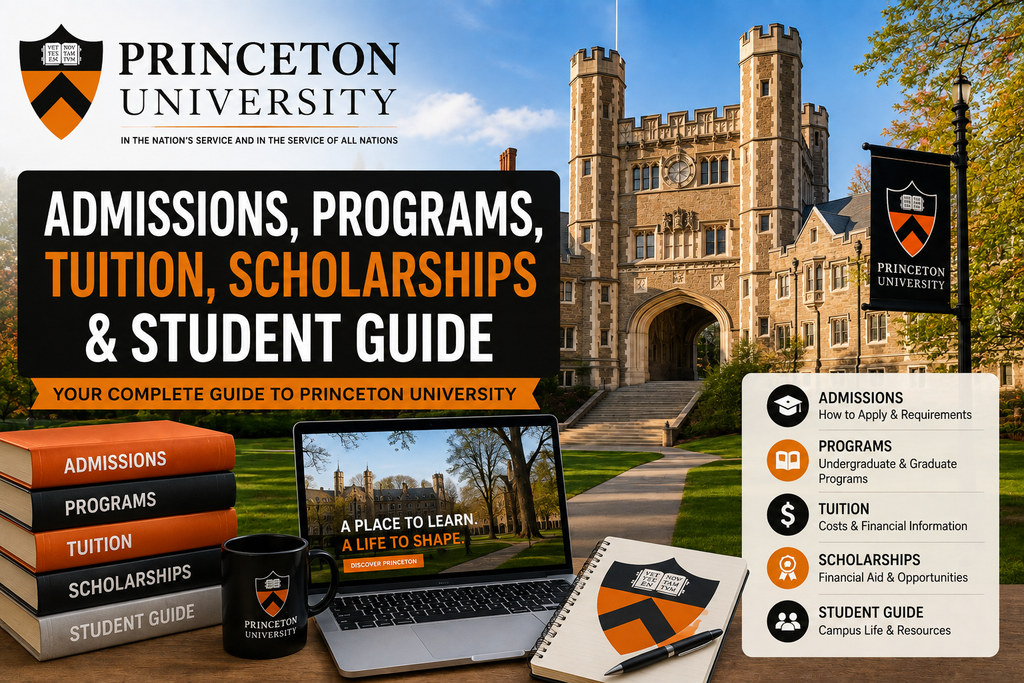
Meta Description: Explore Princeton University admissions, programs, tuition, financial aid, scholarships, campus life, housing, and important information for prospective students.
Recommended URL Slug: /universities/princeton-university/
Search Intent: Informational / University Research
Primary Keyword: Princeton University
Secondary Keywords: Princeton University admissions, Princeton tuition, Princeton scholarships, Princeton financial aid, Princeton programs, Princeton undergraduate programs, Princeton international students, study at Princeton
Introduction
Princeton University is one of the oldest and most respected universities in the United States. Founded in 1746 as the College of New Jersey, Princeton has developed into a private research university known for its strong undergraduate focus, rigorous academics, research opportunities, and close-knit residential community.
Located in Princeton, New Jersey, the university sits between New York City and Philadelphia. Its relatively small undergraduate population creates an academic environment where students can work closely with faculty while still having access to the resources of a major research institution.
For prospective students, Princeton’s reputation is only one factor to consider. Applicants should also understand the university’s academic programs, admission process, tuition and living costs, financial aid, housing system, research opportunities, and student experience.
This guide provides an overview of Princeton University and the information students should know before applying.
Princeton University at a Glance
| Category | Information |
|---|---|
| University | Princeton University |
| Founded | 1746 |
| Original Name | College of New Jersey |
| Location | Princeton, New Jersey |
| University Type | Private research university |
| Undergraduate Population | Approximately 5,800 |
| Undergraduate Degrees | A.B. and B.S.E. |
| Undergraduate Majors | 37 |
| Undergraduate Minors | 69 |
| Campus Size | About 500 acres |
| Early Application Plan | Single-Choice Early Action |
| Early Action Deadline | November 1 |
| Regular Decision Deadline | January 1 |
| 2026–27 Tuition | $68,140 |
| Financial Aid Policy | Need-based; meets 100% of demonstrated need with grant aid |
Princeton’s 2026–27 Undergraduate Announcement describes an undergraduate population of approximately 5,800 students pursuing either the Bachelor of Arts or Bachelor of Science in Engineering. The university also states that its financial aid program provides grants rather than loans.
History and Background
How Princeton University Started
Princeton University was chartered in 1746 as the College of New Jersey. It was the fourth college established in British North America. The institution initially operated in Elizabeth, New Jersey, and later moved to Newark before relocating to Princeton in 1756.
Nassau Hall became an important early home for the College after its move to Princeton.
For approximately 150 years, the institution was known as the College of New Jersey. In 1896, as its academic programs expanded and the institution took on university status, its official name became Princeton University. The Graduate School was established in 1900.
Development and Reputation
Princeton has developed a distinctive academic identity centered on undergraduate education and doctoral research.
The university’s mission emphasizes scholarship, research, and teaching while placing particular importance on undergraduate and doctoral education.
Princeton’s academic environment combines:
- Liberal arts education
- Scientific research
- Engineering
- Humanities
- Social sciences
- Interdisciplinary study
- Independent research
- Faculty mentorship
The university is also known for requiring substantial independent academic work in many undergraduate programs, including junior papers and senior theses.
Academic Programs at Princeton
Undergraduate Programs
Princeton offers two primary undergraduate degrees:
- Bachelor of Arts (A.B.)
- Bachelor of Science in Engineering (B.S.E.)
Students can choose from 37 majors, along with numerous minors and interdisciplinary programs.
Areas of study include:
- African American Studies
- Anthropology
- Architecture
- Art and Archaeology
- Astrophysical Sciences
- Chemical and Biological Engineering
- Chemistry
- Classics
- Computer Science
- Economics
- English
- Geosciences
- History
- Mathematics
- Mechanical and Aerospace Engineering
- Molecular Biology
- Music
- Neuroscience
- Philosophy
- Physics
- Politics
- Psychology
- Religion
- Sociology
- Statistics and Data Science
Princeton also offers interdisciplinary fields and programs that allow students to combine interests across traditional academic boundaries.
Graduate Programs
Princeton also has a major graduate education and research component.
Its graduate programs are especially focused on doctoral education across the humanities, social sciences, natural sciences, and engineering. The university also offers a selected number of master’s programs.
Graduate applicants should check the requirements of their individual department or program because application deadlines, qualifications, funding, and admission procedures vary.
Princeton’s Undergraduate Academic Experience
Liberal Arts and Interdisciplinary Learning
Princeton’s undergraduate curriculum emphasizes learning across multiple disciplines.
Students can explore subjects in:
- Humanities
- Arts
- Social sciences
- Natural sciences
- Engineering
The university describes its undergraduate curriculum as emphasizing learning, creativity, innovation, and collaboration.
This approach can be especially useful for students who want to combine technical subjects with humanities or social sciences.
Independent Research
Independent academic work is an important part of the Princeton undergraduate experience.
Depending on the major, students may complete research projects, junior papers, senior theses, or other forms of independent work.
For example, Princeton’s History Department requires substantial independent research, with students progressing toward a senior thesis based on original historical research.
The university’s emphasis on independent work can help students develop:
- Research skills
- Academic writing
- Critical thinking
- Problem-solving
- Independent analysis
- Communication skills
Princeton University Admissions
Undergraduate Admission
Princeton’s undergraduate admission process is highly selective and holistic.
First-year applicants apply using the Common Application along with Princeton-specific questions. Princeton currently offers:
- Single-Choice Early Action
- Regular Decision
The Single-Choice Early Action program is nonbinding. Students admitted through this process still have until May 1 to decide whether to enroll.
Princeton Application Deadlines
The current first-year deadlines include:
Single-Choice Early Action
- Application deadline: November 1
- Financial aid application: November 9
- Decision notification: Mid-December
Regular Decision
- Application deadline: January 1
- Financial aid application: February 1
- Decision notification: Late March
The optional arts supplement has separate deadlines: November 6 for Single-Choice Early Action and January 8 for Regular Decision.
Students should verify the official Princeton admissions calendar before applying because deadlines and requirements can change.
General Admission Requirements
A Princeton first-year application generally includes:
- Common Application
- Princeton-specific questions
- Application fee or fee waiver
- School report
- School counselor recommendation
- Official transcript
- Two teacher evaluations
- Graded written paper
- Standardized test information when applicable
- Additional materials for certain applicants
The graded written paper is an important feature of Princeton’s application requirements. Applicants are asked to provide a piece of academic work that demonstrates analytical or writing ability.
Students should carefully follow the current application instructions because Princeton may update individual requirements.
SAT and ACT Requirements
Princeton’s testing policy is currently changing.
For the 2026–27 admission cycle, applicants seeking to enroll in fall 2027 remain test optional. Students who apply without SAT or ACT scores will not be disadvantaged in the admissions process.
However, Princeton has announced that it will return to requiring standardized testing beginning with the 2027–28 admission cycle. First-year and transfer applicants seeking to enroll in fall 2028 will need to submit SAT or ACT scores.
This distinction is important for students planning ahead.
Applicants should always check Princeton’s latest standardized-testing policy based on the year they intend to enroll.
International Students at Princeton
Applying From Outside the United States
Princeton welcomes students from around the world.
International applicants generally complete the same core undergraduate application process, but their academic records may differ depending on their educational system.
Applicants may need to provide:
- Secondary school transcripts
- National examination results
- Predicted examination results where applicable
- Teacher evaluations
- English-language testing where required
- Financial aid documentation
Princeton’s application deadlines page currently lists TOEFL, IELTS Academic, or PTE Academic requirements where applicable for international applicants.
Students should review Princeton’s official international applicant guidance to determine which requirements apply to their specific educational background.
Tuition and Costs at Princeton
Princeton Tuition
For the 2026–27 academic year, Princeton lists undergraduate tuition at $68,140.
Tuition is only one part of the overall cost of attending the university.
Students may also have expenses related to:
- Housing
- Food
- Books and supplies
- Personal expenses
- Transportation
- Student fees
- Other educational costs
The actual amount a student pays can be considerably lower after financial aid.
Financial Aid Can Change the Net Cost
Princeton emphasizes that its published tuition should not be viewed as the amount every student will pay.
The university states that its financial aid program is designed to make Princeton accessible to qualified students regardless of their financial circumstances.
For this reason, prospective students should use Princeton’s financial aid resources and net price calculator rather than judging affordability from tuition alone.
Scholarships and Financial Aid
Need-Based Financial Aid
Princeton’s undergraduate financial aid program is based on demonstrated financial need.
The university states that Princeton admission is need-blind, meaning applying for financial aid does not put an applicant at a disadvantage during the admissions process.
If a student is admitted, Princeton says it will meet 100% of demonstrated financial need with grant aid.
This means Princeton’s financial aid package is designed around grants rather than traditional student loans.
Grants Instead of Loans
One of the distinctive features of Princeton’s financial aid system is its no-loan approach.
Princeton states that its financial aid program provides grants rather than loans, meaning students receiving this aid do not have to repay the grant portion after graduation.
This can make Princeton substantially more affordable for students who qualify for significant financial assistance.
Financial Aid for International Students
Princeton also considers financial need for international applicants.
International students should carefully complete the financial aid application requirements by the applicable deadline.
Because international financial aid can be an important part of the admission decision and affordability calculation, applicants should not assume that published tuition represents their eventual cost.
Campus and Student Life
Princeton Campus
Princeton University is located in Princeton, New Jersey, approximately midway between New York City and Philadelphia.
The university’s campus covers approximately 500 acres and combines historic buildings with modern academic, residential, research, athletic, and cultural facilities.
Its location gives students access to a college-town environment while also providing relatively convenient connections to major cities.
Residential College System
Residential life is one of Princeton’s defining characteristics.
The university currently has seven residential colleges:
- Butler College
- Forbes College
- Mathey College
- Rockefeller College
- Whitman College
- Yeh College
- Huo College
First- and second-year students are required to live in the residential college system. The colleges provide housing, dining, academic advising, social activities, and student support.
Princeton guarantees undergraduate housing for all four years.
Student Organizations
Students have many opportunities to participate in activities beyond academics.
Princeton reports more than 500 student organizations, along with sports clubs, chaplaincies, and campus centers.
Students can participate in:
- Academic clubs
- Cultural organizations
- Performing arts
- Student publications
- Sports
- Community service
- Political organizations
- Religious and spiritual groups
- Entrepreneurship
- Research activities
This range of activities allows students to build communities around interests outside their academic major.
Research Opportunities
Princeton is a major research university, but its undergraduate education remains a central part of the institution.
Students can participate in faculty research, independent projects, laboratory work, internships, and interdisciplinary programs.
The university’s emphasis on independent work is especially important for students considering graduate school or research-intensive careers.
Faculty members work closely with undergraduates on junior-year independent work and senior theses.
Students interested in research can explore opportunities in fields such as:
- Physics
- Mathematics
- Computer science
- Engineering
- Economics
- Biology
- Public policy
- History
- Politics
- Neuroscience
- Environmental sciences
- Humanities
Popular Fields of Study
Princeton provides academic opportunities across a wide range of disciplines.
Computer Science
Computer science students can study areas related to computation, algorithms, artificial intelligence, systems, theory, and applications.
Economics
Princeton’s economics program provides students with opportunities to study economic theory, data, policy, markets, and related subjects.
Engineering
Engineering students can pursue fields such as chemical and biological engineering, civil and environmental engineering, electrical and computer engineering, and mechanical and aerospace engineering.
Public Policy
Students interested in government and public service can explore programs connected with politics, public policy, international affairs, and related fields.
Humanities
Princeton has extensive undergraduate opportunities in history, philosophy, literature, languages, classics, art, music, and other humanities disciplines.
Rankings and Reputation
Princeton is widely recognized as one of the leading universities in the United States and internationally.
Its reputation is based on factors including:
- Academic quality
- Undergraduate teaching
- Faculty
- Research
- Independent scholarship
- Financial aid
- Alumni achievements
- Residential education
- Academic resources
However, students should not choose Princeton solely because of its ranking.
Rankings differ in methodology and can change from year to year.
When comparing Princeton with another university, students should also consider:
- Intended major
- Financial aid
- Campus culture
- Location
- Class environment
- Research opportunities
- Housing
- Career goals
- Student support
Why Students Choose Princeton University
1. Strong Undergraduate Focus
Princeton places significant emphasis on undergraduate education and faculty interaction.
2. Close-Knit Campus
The relatively small undergraduate population and residential college system create a close campus community.
3. Independent Research
Many undergraduate programs include substantial independent work, including junior papers and senior theses.
4. Strong Financial Aid
Princeton meets 100% of demonstrated financial need with grant aid for admitted students who qualify.
5. No-Loan Financial Aid Approach
The university’s financial aid program uses grants rather than traditional loans.
6. Broad Academic Options
Students can study humanities, social sciences, natural sciences, engineering, and interdisciplinary subjects.
7. Residential Education
Students live and learn within a residential college system that combines housing, advising, dining, and social activities.
Pros and Considerations
Pros
- Strong academic reputation
- Excellent undergraduate focus
- Broad selection of majors
- Strong faculty interaction
- Extensive research opportunities
- Independent academic work
- Seven residential colleges
- Four-year housing guarantee
- Need-blind admission
- 100% demonstrated need met with grant aid
- No-loan financial aid approach
- Convenient location between New York City and Philadelphia
- Strong student organizations and extracurricular opportunities
Considerations
- Admission is highly competitive
- Academic workload can be demanding
- Published tuition is high before financial aid
- Students are expected to take independent academic work seriously
- The residential college environment may feel more close-knit than a very large university
- International applicants need to carefully review documentation and financial aid requirements
- Standardized testing policies are changing for future admission cycles
Frequently Asked Questions
Is Princeton University difficult to get into?
Yes. Princeton has a highly selective undergraduate admission process and evaluates applicants holistically.
How much is Princeton tuition?
For the 2026–27 academic year, Princeton lists undergraduate tuition at $68,140.
Does Princeton offer scholarships?
Princeton primarily provides need-based financial aid rather than traditional merit scholarships. The university states that admitted students with demonstrated financial need receive aid designed to meet 100% of that need through grant aid.
Does Princeton have need-blind admission?
Yes. Princeton states that its undergraduate admission process is need-blind, meaning applying for financial aid does not disadvantage an applicant in admission.
Does Princeton require the SAT or ACT?
For the 2026–27 admission cycle, Princeton remains test optional. The university plans to require SAT or ACT scores beginning with the 2027–28 admission cycle for students seeking to enroll in fall 2028.
What is Princeton’s application deadline?
The current first-year deadlines are November 1 for Single-Choice Early Action and January 1 for Regular Decision.
Where is Princeton University located?
Princeton University is located in Princeton, New Jersey, between New York City and Philadelphia.
How many undergraduate students attend Princeton?
Princeton’s 2026–27 Undergraduate Announcement describes an undergraduate population of approximately 5,800 students.
Does Princeton guarantee student housing?
Yes. Princeton guarantees undergraduate students on-campus housing for all four years. First- and second-year students are required to live on campus.
Does Princeton have residential colleges?
Yes. Princeton currently has seven residential colleges that form the center of undergraduate residential life.
Is Princeton good for international students?
Princeton can be an attractive choice for international students who want a rigorous undergraduate education, strong faculty interaction, research opportunities, and substantial need-based financial aid. International applicants should carefully review the university’s current application and financial-aid requirements before applying.
Conclusion
Princeton University combines a long academic history with a strong focus on undergraduate education, research, independent scholarship, and residential community.
Its academic structure gives students opportunities to explore the humanities, sciences, engineering, social sciences, and interdisciplinary fields while developing deeper expertise in a chosen area.
For prospective applicants, Princeton’s financial aid program is another important consideration. The university states that admission is need-blind and that it meets 100% of demonstrated financial need with grant aid.
At the same time, admission is highly competitive, and students should prepare carefully for the application process. Applicants should also pay attention to Princeton’s changing standardized-testing policy, particularly if they are planning for a future admission cycle.
For students looking for a highly academic, residential university with strong undergraduate teaching, independent research, and significant financial aid, Princeton can be an excellent institution to consider.
Internal Linking Suggestions for UniCoStudy.com
Once the related articles are published, this Princeton University guide can link naturally to:
- Harvard University: Admissions, Programs, Tuition, Scholarships & Student Guide
- Stanford University: Admissions, Programs, Tuition, Scholarships & Student Guide
- Massachusetts Institute of Technology (MIT): Admissions, Programs, Tuition, Scholarships & Student Guide
- Yale University: Admissions, Programs, Tuition, Scholarships & Student Guide
- How to Apply to U.S. Universities
- U.S. University Admission Requirements
- How to Prepare a Strong University Application
- SAT and ACT: What Students Should Know
- How to Find Scholarships for U.S. Universities
- Merit-Based vs Need-Based Financial Aid
- How U.S. University Rankings Work
- How to Compare Two U.S. Universities Before Applying
- Guide to Student Life at U.S. Universities
Image Alt-Text Suggestion
Princeton University campus with historic buildings and students in Princeton New Jersey
Authoritative Sources for Publication Checks
For final publication checks, prioritize Princeton University’s official admissions, financial aid, academics, undergraduate announcement, institutional research, housing, and university profile pages for current tuition, deadlines, testing policies, enrollment figures, academic programs, and financial-aid rules.