
SEO Title: MIT: Admissions, Tuition, Programs, Scholarships & Student Guide
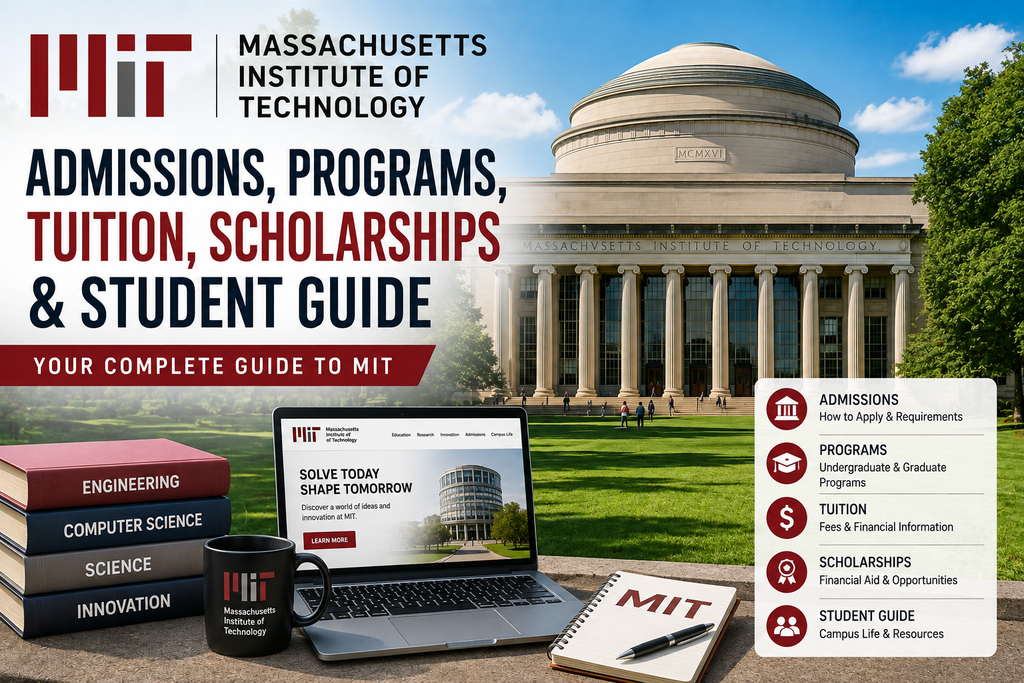
Meta Description: Learn about MIT admissions, academic programs, tuition costs, financial aid, scholarships, campus life, and important information for prospective students.
Recommended URL Slug: /universities/massachusetts-institute-of-technology/
Search Intent: Informational / University Research
Primary Keyword: Massachusetts Institute of Technology
Secondary Keywords: MIT admissions, MIT tuition, MIT scholarships, MIT financial aid, MIT programs, MIT undergraduate programs, MIT international students, study at MIT, MIT acceptance rate
Introduction
The Massachusetts Institute of Technology (MIT) is one of the world’s best-known universities for science, technology, engineering, mathematics, research, and innovation.
Founded in 1861, MIT was created with an emphasis on practical education and the connection between scientific knowledge and real-world problems. The Institute began in Boston and moved to its present Cambridge location in 1916.
Today, MIT is a private, independent, coeducational research university in Cambridge, Massachusetts. Its academic community includes thousands of undergraduate and graduate students, along with faculty and researchers working across a wide range of disciplines.
Although MIT is particularly famous for engineering and computer science, its academic offerings extend beyond technology. Students can study economics, management, architecture, biology, mathematics, humanities, social sciences, music, political science, and many interdisciplinary subjects.
For students considering MIT, the university’s reputation is only one part of the decision. Prospective applicants should also understand the admissions process, academic programs, cost of attendance, financial aid, campus culture, research opportunities, and student life.
This guide covers the major points students should know before applying to MIT.
MIT at a Glance
| Category | Information |
|---|---|
| University | Massachusetts Institute of Technology |
| Common Name | MIT |
| Founded | 1861 |
| First Students Admitted | 1865 |
| Current Location | Cambridge, Massachusetts |
| Campus Size | 168 acres |
| Undergraduate Students | 4,561 |
| Graduate Students | 7,255 |
| Undergraduate Majors | 56 |
| Undergraduate Minors | 62 |
| First-Year Application | MIT Application Portal |
| Early Action Deadline | November 1 |
| Regular Action Deadline | January 4 |
| SAT/ACT | Required |
| 2026–27 Tuition | $66,720 |
| 2026–27 Estimated Cost of Attendance | $92,760 |
MIT’s current facts report 11,816 total students, including 4,561 undergraduates and 7,255 graduate students. The Institute currently lists 56 undergraduate majors and 62 undergraduate minors.
History and Background
How MIT Started
MIT was founded in 1861 by William Barton Rogers, a scientist who wanted to create a different kind of educational institution.
Rogers emphasized practical education, scientific investigation, teaching laboratories, and the relationship between learning and real-world problems. MIT admitted its first students in 1865, four years after its founding charter was approved.
The Institute initially operated in Boston before moving across the Charles River to Cambridge in 1916.
This early emphasis on practical learning helped establish a culture that continues to influence MIT today.
Development and Reputation
MIT has grown from a small technical institution into a major global research university.
Its mission focuses on advancing knowledge and educating students in science, technology, and other areas of scholarship that can contribute to major challenges facing society.
The Institute is particularly associated with:
- Engineering
- Computer science
- Artificial intelligence
- Mathematics
- Physics
- Biology
- Economics
- Entrepreneurship
- Research
- Technology and innovation
However, MIT’s academic community is much broader than engineering and technology alone.
Academic Programs at MIT
Undergraduate Programs
MIT currently offers 56 undergraduate majors and 62 undergraduate minors. Its programs cover engineering, science, computing, architecture, management, humanities, arts, and social sciences.
Examples of undergraduate majors include:
- Aerospace Engineering
- Artificial Intelligence and Decision Making
- Biological Engineering
- Biology
- Brain and Cognitive Sciences
- Business Analytics
- Chemical Engineering
- Chemistry
- Civil and Environmental Engineering
- Computer Science and Engineering
- Economics
- Electrical Engineering with Computing
- Finance
- Mathematics
- Mechanical Engineering
- Physics
- Political Science
- Architecture
- Music
- Writing
- Urban Science and Planning with Computer Science
This combination of technical and nontechnical programs allows students to explore different academic interests.
Graduate Programs
MIT also offers extensive graduate education.
Graduate degrees include:
- Master of Architecture
- Master of Business Administration
- Master of Engineering
- Master of Finance
- Master of Science
- Doctor of Philosophy
- Doctor of Science
MIT’s graduate education covers fields across its academic schools and departments.
Graduate applicants should review the requirements of their specific department because application procedures, deadlines, testing requirements, and funding opportunities can vary.
Popular Fields of Study
MIT is particularly well known for programs involving science, technology, engineering, mathematics, and computing.
Popular areas students may consider include:
Computer Science
Computer science at MIT covers areas such as algorithms, artificial intelligence, software, systems, computation, and theoretical computer science.
Engineering
MIT offers a wide range of engineering fields, including mechanical, electrical, chemical, aerospace, biological, civil, and environmental engineering.
Mathematics
Students interested in mathematics can explore pure and applied mathematics as well as interdisciplinary programs involving computing, economics, and science.
Physics
Physics is another major area of study at MIT, with opportunities connected to research and advanced scientific investigation.
Economics and Finance
MIT also offers programs in economics, finance, business analytics, and management.
Biology and Brain Sciences
Students interested in life sciences can study biology, biological engineering, brain and cognitive sciences, and related fields.
MIT Undergraduate Education
A Strong Foundation
MIT’s undergraduate education combines specialized study with a broad academic foundation.
Students complete the Institute’s General Institute Requirements, which provide exposure to areas such as mathematics, science, humanities, arts, and social sciences.
This structure means students are not expected to focus exclusively on their major from the beginning.
Choosing a Major
MIT students do not necessarily have to enter the university already committed to a specific major.
According to MIT’s enrollment information, students generally do not enroll in an academic department until the beginning of their sophomore year and can defer their choice of course of study until the end of that year.
This can be useful for students who have several interests and want time to explore different subjects.
Experiential Learning
Hands-on learning is an important part of MIT’s academic culture.
MIT reports that nearly 65% of undergraduates participate each year in the Undergraduate Research Opportunities Program (UROP).
Research, projects, laboratory work, internships, and international experiences can complement classroom learning.
MIT Admissions
Undergraduate Admission
Admission to MIT is extremely competitive.
For the Class of 2029, MIT reports 29,281 applicants and 1,334 admits, equivalent to approximately 4.6% of applicants.
MIT uses a holistic admissions process. Academic preparation is important, but the university also considers other parts of an applicant’s background, experiences, interests, activities, and potential.
Applicants should therefore avoid thinking of admission as simply a matter of achieving a particular test score.
MIT Application Requirements
First-year applicants use the MIT application portal.
MIT currently requires applicants to submit:
- MIT first-year application
- Essays and personal information
- Activities and academic information
- Secondary School Report
- Academic transcript
- Two teacher recommendations
- SAT or ACT scores
- Application fee or fee waiver
MIT recommends that one recommendation come from a math or science teacher and another from a humanities, social science, or language teacher.
Creative portfolios are optional and may be submitted by students in areas such as research, performing arts, visual arts, or making.
MIT Application Deadlines
For first-year applicants, MIT currently lists:
- Early Action: November 1
- Regular Action: January 4
MIT’s current admissions page also states that admission decisions are released in mid-December for Early Action and mid-March for Regular Action.
The application process and dates can change, so students should verify deadlines on MIT Admissions before applying.
Early Action vs Regular Action at MIT
MIT’s Early Action program is non-binding and non-restrictive.
The university states that there is no difference in the admission review process or criteria between Early Action and Regular Action. Applying Early Action does not provide an admission advantage; the primary benefit is receiving the decision earlier.
This can be useful for students who are ready to submit a strong application by the November deadline.
Students who need additional time to strengthen their application may choose Regular Action instead.
SAT and ACT Requirements
MIT currently requires the SAT or ACT for first-year applicants.
MIT does not require the ACT writing or science sections or the optional SAT essay. The university accepts both paper and digital SAT formats.
MIT uses standardized test scores as one part of its broader application review rather than treating a particular score as an automatic admission threshold.
For testing deadlines:
- Early Action applicants must take required tests before November 30.
- Regular Action applicants must take required tests before December 31.
Applicants can self-report their scores and MIT verifies them if the student enrolls.
Students should always check the latest testing requirements before submitting an application.
International Students at MIT
Applying as an International Student
MIT welcomes students from around the world.
Its 2025–2026 enrollment statistics show students from all 50 U.S. states, the District of Columbia, four territories, and 137 foreign countries. MIT reported 3,437 international students across its student population.
International applicants follow the same basic undergraduate admission process but may need to provide academic documents appropriate to their educational system.
Applicants studying under systems such as:
- A-Levels
- International Baccalaureate
- National curricula
- Other international secondary-school systems
should carefully review MIT’s application instructions.
English Language Preparation
MIT strongly recommends English proficiency examinations for certain non-native English speakers.
The university’s current admissions requirements explain that applicants should review the English proficiency guidance based on their educational and language background.
International students should make sure they understand which tests, if any, are appropriate for their individual circumstances.
Tuition and Costs at MIT
MIT Tuition
MIT’s undergraduate tuition for the 2026–2027 academic year is $66,720 according to MIT Student Financial Services.
The university estimates the full cost of attendance at approximately $92,760 for the 2026–2027 academic year before financial aid.
The total cost of attendance can include:
- Tuition
- Housing
- Food
- Student fees
- Books and supplies
- Personal expenses
- Other required or estimated costs
Students should remember that the published cost is not necessarily the amount every student pays.
MIT’s financial aid can substantially reduce the net cost for eligible students.
Housing and Food
Housing and food are significant parts of the total cost of attending MIT.
The university has numerous student residences and a residential campus environment.
MIT currently lists 20 student residence halls and a 168-acre campus in Cambridge.
Students should review the latest Student Financial Services budget before planning their annual finances.
Scholarships and Financial Aid
MIT Need-Based Financial Aid
One of MIT’s most important features for prospective students is its need-based financial aid program.
MIT states that it meets 100% of demonstrated financial need for undergraduate students. The university also describes its admissions process as need-blind, meaning a student’s ability to pay is not considered in the admission decision.
MIT’s aid is based primarily on financial need rather than academic merit.
Tuition-Free Opportunities
Beginning with the 2025–2026 academic year, MIT states that students from families with income below $200,000, with typical assets, attend MIT tuition-free.
MIT also states that families with total income below $100,000, with typical assets, are not expected to contribute toward their student’s MIT education.
These are general guidelines rather than guarantees for every family. Individual financial circumstances are used to determine aid.
Financial Aid for International Students
International students can receive MIT financial aid.
MIT states that international students are considered for aid using the same general need-based approach and that the Institute is committed to meeting 100% of demonstrated financial need for international students.
International students applying for financial aid generally need to submit the CSS Profile and parental tax returns or income documentation.
This can make MIT financially accessible to some international students despite the university’s high published cost of attendance.
Campus and Student Life
MIT’s Cambridge Campus
MIT is located in Cambridge, Massachusetts, along the Charles River.
Its 168-acre campus includes academic buildings, laboratories, residences, recreational spaces, gardens, and public art.
The campus is also close to Boston, giving students access to the cultural, professional, academic, and recreational opportunities of the wider Boston area.
Student Organizations
MIT students can participate in a large variety of organizations and activities.
These may include:
- Academic clubs
- Engineering organizations
- Entrepreneurship groups
- Arts organizations
- Music groups
- Sports
- Cultural organizations
- Student publications
- Community service
- Research organizations
- Technology projects
MIT reports more than 60 music, theater, visual arts, writing, and dance groups.
Arts and Culture
Although MIT is strongly associated with science and technology, arts and creative activities are also part of campus life.
MIT reports that more than half of incoming first-year students have training in the arts, while more than half of undergraduates enroll in arts courses each year.
The campus also includes museums, galleries, public artwork, and performance opportunities.
Research Opportunities
Research is central to MIT’s identity.
The Institute reports more than 70 research centers, laboratories, and programs, along with hundreds of companies collaborating with MIT faculty and students on research.
Undergraduate students can participate in research through programs such as UROP.
MIT reports that nearly 65% of undergraduates participate in UROP each year.
Research opportunities can be particularly valuable for students interested in:
- Graduate school
- Engineering
- Computer science
- Scientific research
- Artificial intelligence
- Biotechnology
- Entrepreneurship
- Technology development
- Public policy
- Interdisciplinary research
Rankings and Reputation
MIT is consistently regarded as one of the world’s leading institutions for higher education, research, science, engineering, and technology.
Its reputation is supported by:
- Research achievements
- Faculty
- Academic programs
- Innovation
- Entrepreneurship
- Scientific discoveries
- Alumni contributions
- Industry connections
- Interdisciplinary education
However, students should not choose a university solely because of its position in a ranking.
University rankings use different methodologies and can change from year to year.
When comparing MIT with another university, students should also consider:
- Academic programs
- Cost after financial aid
- Campus culture
- Research opportunities
- Career goals
- Location
- Student support
- Housing
- Personal interests
Why Students Choose MIT
1. Strong STEM Programs
MIT is especially well known for science, technology, engineering, mathematics, and computing.
2. Hands-On Education
MIT’s educational philosophy emphasizes applying knowledge to practical problems.
3. Research Opportunities
A large proportion of MIT undergraduates participate in research through programs such as UROP.
4. Flexible Academic Exploration
Students have time to explore academic interests before formally choosing a course of study.
5. Financial Aid
MIT’s need-based financial aid program meets 100% of demonstrated financial need.
6. International Community
MIT attracts students from many countries and backgrounds, creating a diverse academic environment.
7. Innovation and Entrepreneurship
MIT has a strong culture of innovation and entrepreneurship, making it attractive to students interested in developing new technologies, products, research projects, and businesses.
Pros and Considerations
Pros
- World-renowned academic reputation
- Excellent science and engineering programs
- Strong computer science and technology programs
- Extensive research opportunities
- Hands-on learning culture
- Large selection of majors and minors
- Need-blind undergraduate admissions
- Financial aid meeting 100% of demonstrated need
- Financial aid available to international students
- Strong innovation and entrepreneurship environment
- Location near Boston
Considerations
- Admission is extremely competitive
- Academic workload can be demanding
- Published cost of attendance is high before financial aid
- STEM-focused programs may require strong preparation in mathematics and science
- Students should carefully plan their academic workload
- Cambridge and the wider Boston area can be expensive
- International students need to plan carefully for documentation, testing, finances, and immigration requirements
Frequently Asked Questions
Is MIT difficult to get into?
Yes. MIT admission is extremely competitive. For the Class of 2029, MIT reported 29,281 applicants and 1,334 admits, or approximately 4.6% of applicants.
How much does MIT cost?
For 2026–2027, MIT lists undergraduate tuition at $66,720, while its full price of attendance is approximately $92,760 before financial aid.
Does MIT offer scholarships?
MIT provides need-based financial aid rather than relying on traditional academic merit scholarships. The Institute meets 100% of demonstrated financial need for eligible undergraduate students.
Can international students receive financial aid at MIT?
Yes. MIT states that international students are considered for financial aid and that the Institute is committed to meeting 100% of demonstrated financial need.
What is MIT’s application deadline?
The current first-year deadlines are November 1 for Early Action and January 4 for Regular Action.
Does MIT require the SAT or ACT?
Yes. MIT currently requires the SAT or ACT for first-year applicants.
What majors does MIT offer?
MIT offers 56 undergraduate majors across areas including engineering, computer science, mathematics, science, architecture, management, humanities, arts, and social sciences.
When do MIT students choose a major?
MIT students generally do not enroll in an academic department until the beginning of their sophomore year and may defer their course-of-study decision until the end of that year.
Where is MIT located?
MIT is located in Cambridge, Massachusetts, across the Charles River from Boston.
Is MIT good for international students?
MIT can be an excellent choice for international students interested in research, science, engineering, computing, entrepreneurship, and interdisciplinary education. Its financial aid program also provides need-based assistance to international students.
Conclusion
The Massachusetts Institute of Technology combines rigorous academic study, practical problem-solving, research, and innovation.
Although MIT is particularly famous for science, technology, engineering, and mathematics, its undergraduate programs also cover fields such as economics, management, architecture, humanities, arts, social sciences, and interdisciplinary studies.
Admission is highly competitive, and students should prepare carefully for the application process. MIT currently requires the SAT or ACT, along with academic records, recommendations, essays, activities, and other application materials.
The published cost of attendance may appear high, but MIT’s need-based financial aid system can significantly reduce the amount eligible families pay. The Institute states that it meets 100% of demonstrated financial need and follows need-blind admissions for undergraduate applicants. International students can also receive need-based financial aid.
For students who enjoy solving complex problems, exploring new ideas, conducting research, and applying knowledge to real-world challenges, MIT can be a particularly strong university to consider.
Internal Linking Suggestions for UniCoStudy.com
Once the related articles are published, this MIT guide can link naturally to:
- Harvard University: Admissions, Programs, Tuition, Scholarships & Student Guide
- Stanford University: Admissions, Programs, Tuition, Scholarships & Student Guide
- Princeton University: Admissions, Programs, Tuition, Scholarships & Student Guide
- How to Apply to U.S. Universities
- U.S. University Admission Requirements
- How to Prepare a Strong University Application
- SAT and ACT: What Students Should Know
- How to Find Scholarships for U.S. Universities
- Scholarships for International Students in the United States
- Merit-Based vs Need-Based Financial Aid
- How U.S. University Rankings Work
- How to Compare Two U.S. Universities Before Applying
Image Alt-Text Suggestion
Massachusetts Institute of Technology MIT campus and students in Cambridge Massachusetts
Authoritative Sources for Publication Checks
For final publication updates, use MIT’s official admissions, Student Financial Services, Registrar, MIT Facts, and academic pages to verify current deadlines, tuition, financial-aid policies, testing requirements, enrollment figures, and program information.